How to Build an AI Marketing System: A Step-by-Step Guide for 2026

Most people who understand AI marketing systems get stuck at the same point. Not the concept — the sequence. What comes first. What depends on what. What to skip entirely. A structured AI marketing workflow delivers 3 to 5 times the return of scattered tool adoption, according to AgreedTechnologies (2026). The sequence is the strategy.
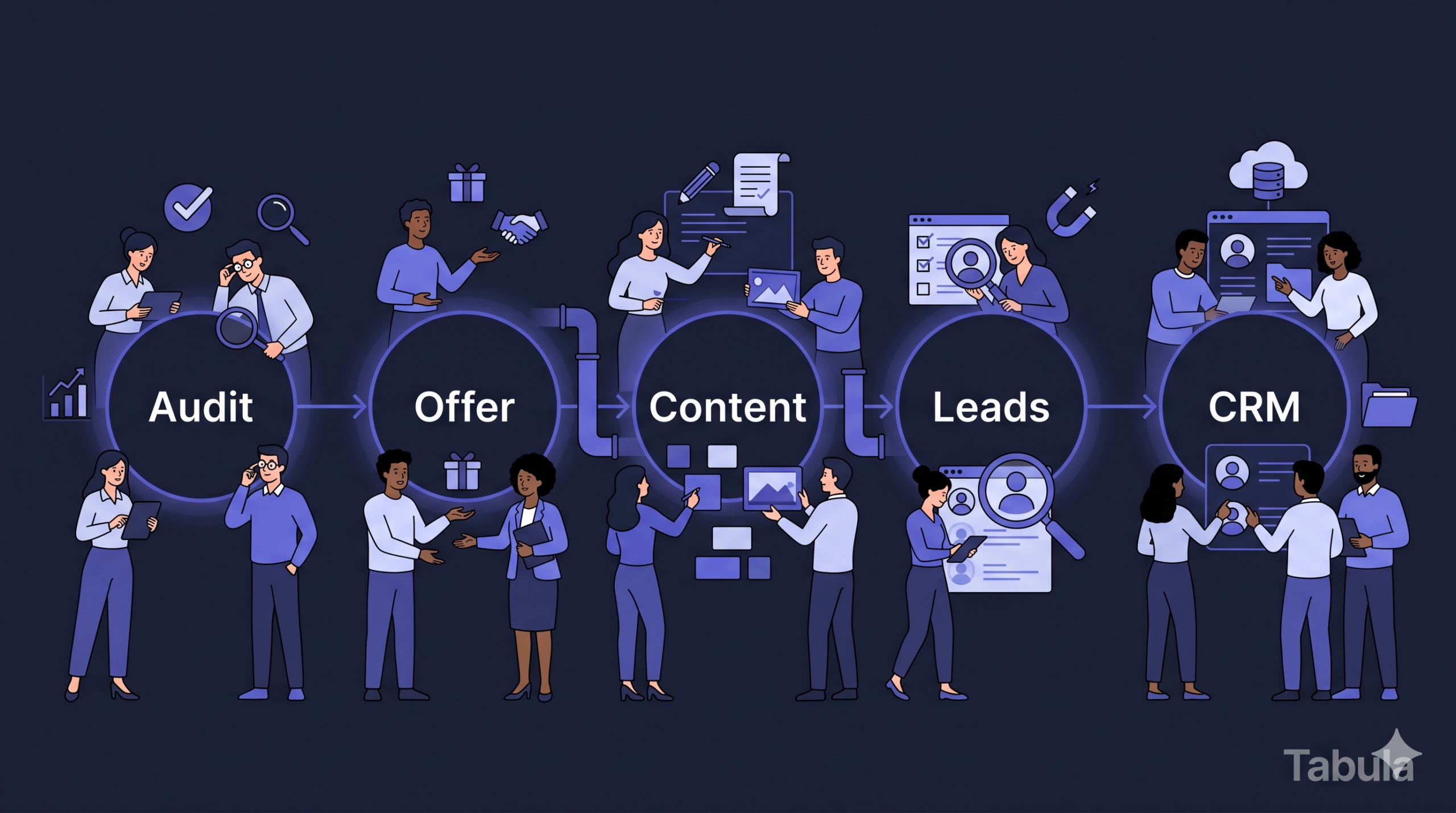
This guide walks through five steps in the exact order they should be built, with the logic behind each one. It is not a tool list. It is a build sequence. If you still need the conceptual foundation before working through these steps, start with what an AI marketing system actually is and come back here when you are ready to build.
One honest caveat before you start: building this properly takes 60 to 90 days. Businesses that try to implement everything in two weeks almost always abandon it by week three. The steps below are phased for a reason.
Before You Build Anything — The Audit Step Most Businesses Skip
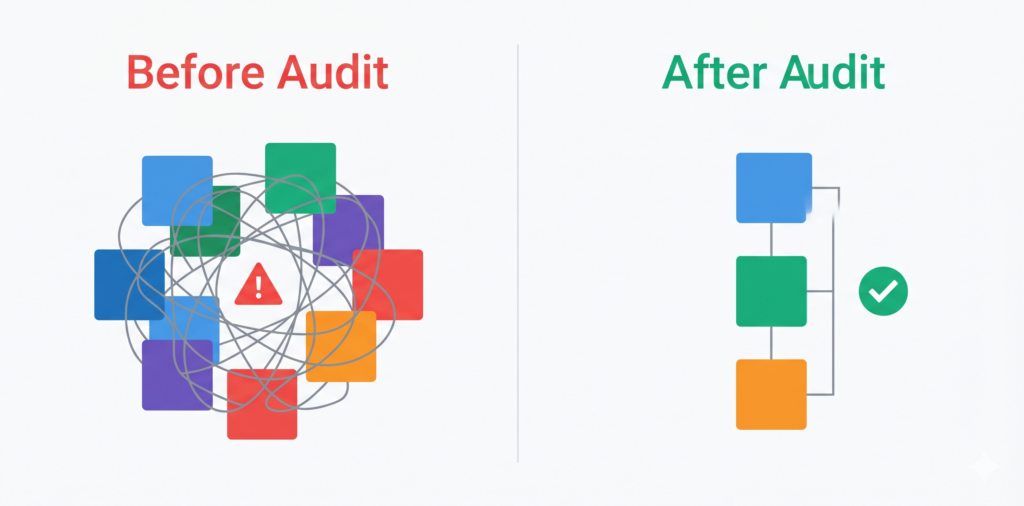
The most common mistake in building an AI marketing system is starting with tools. The right starting point is understanding what you already have, what is working, and what is creating noise in your current setup.
Inventory every tool and channel you are currently paying for
List every subscription, every platform, every channel where you are active. Most businesses at this stage discover they are paying for 4 to 6 overlapping or redundant tools they barely use. The goal is not to immediately cancel anything — it is to see the full picture before adding a single new piece. AI systems built on top of fragmented, unused infrastructure compound the problem rather than solve it. As one 2026 marketing operations report from Promarkia puts it: if your data is messy, AI will produce confident nonsense at scale.
Identify what is actually generating leads or revenue right now
Open your analytics and find the two or three activities that directly contribute to leads or sales. Not the ones you spend the most time on — the ones producing results. These become the core of your system. Everything else either gets automated, reduced, or removed. This clarity matters because AI amplifies your direction. If the direction is wrong before you build, the system makes it wrong at higher speed and volume.
Check your data foundation before selecting any tools
AI tools are only as good as the information they operate on. According to The Marketing Centre (2026), poor-quality, fragmented data leads to poor outcomes regardless of how advanced the tool. Before choosing a CRM, an automation platform, or a content tool, confirm that your customer data is consistent, accessible, and correctly attributed. Data quality is the single most common reason AI marketing implementations fail — not tool selection, not budget, not team skill.
Step 1 — Define Your Core Offer and Ideal Customer Before Touching Any Tool
This step feels like it should already be done. For most businesses it is not — not with the specificity a marketing system actually requires to function.
Your system needs one clear offer to build around
An AI marketing system cannot optimize for vague goals. It needs a specific offer, a specific customer, and a specific outcome to drive toward. If your answer to “what is your core offer” takes longer than two sentences, the system will dilute it across every channel and format it touches. Write one sentence that states exactly what you sell, to whom, and what result it produces. That sentence becomes the brief every piece of content and every automated workflow is written against.
Define your customer with behavioral precision, not demographic labels
“Business owners aged 35 to 55” is not a useful customer definition for a marketing system. “Business owners who have tried a marketing agency, felt they had no ownership of the results, and are now evaluating whether to bring marketing in-house” is. That level of specificity determines which channels your system targets, what content it produces, and how it segments and scores leads. How to use AI for marketing covers how AI tools use this specificity to personalize at scale across every touchpoint.
Pressure-test the offer before building the system around it
Run the offer past five real customers or prospects before committing it to automation. Ask them to describe the problem it solves in their own words. If their description does not match yours, the offer needs refinement. A system built around a misaligned offer will generate traffic, leads, and automated follow-ups — all pointed in the wrong direction. Fix the message before the machine amplifies it.
Step 2 — Choose Your Content Engine (One Channel, Not Six)
The most common system-building error after the audit is choosing too many channels. A system built on three channels done consistently outperforms a system spread across six channels done sporadically every time.
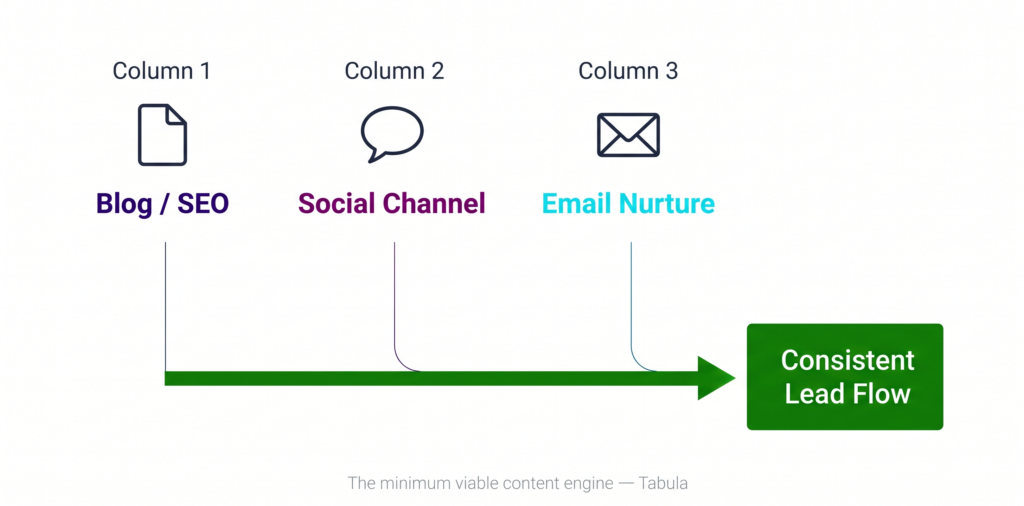
Pick one blog, one social channel, and email — then stop
These three form the minimum viable content engine for almost every business. The blog builds long-term organic and AI search authority. The social channel builds trust and drives traffic back to content — and for businesses that need help getting that social presence right, Tabula’s organic social media services are built to integrate directly into this content engine layer.
Email nurtures existing leads toward a decision. Adding more channels before these three are running consistently is not growth — it is scope creep that dilutes execution and produces nothing measurable. AI content marketing consistency covers the operational side of keeping this engine running without burning out your team or your time.
Use AI to multiply output, not replace strategy
AI tools at this stage handle first drafts, content repurposing, scheduling, and distribution. They should not be writing your strategy or deciding what topics to cover — those decisions require the customer specificity you defined in Step 1.
A business that uses AI to produce more generic content faster is not building a system. It is accelerating noise. Best AI tools covers which tools integrate well at this stage and which ones create more work than they save.
Build your content around search and AI discoverability from day one
Every piece of content your engine produces should be structured for both Google and AI search tools like ChatGPT and Perplexity. That means definition-first openings, FAQ sections at the bottom, and named frameworks inside each post. Content built this way earns citations in AI-generated answers, which drives traffic without requiring a click.
How to get found in ChatGPT and Perplexity covers the exact structural requirements for AI search visibility. Tabula’s professional SEO services are designed to handle this layer for businesses that want it done correctly from the start.
Step 3 — Build Your Lead Capture and Nurture Layer
Content without a lead capture mechanism is brand building, not system building. This step converts the traffic your content engine generates into leads your business can actually follow up with.
One landing page, one offer, one outcome
Build a single landing page with a specific, valuable offer — a free audit, a guide, a checklist, or a consultation. Connect it to a 3 to 5 email welcome sequence that delivers the offer, establishes credibility, and invites a clear next step. This structure outperforms most business marketing setups in practice because it removes ambiguity from the conversion path.
Every piece of content in your engine points back to this page. If your current website is not built to convert visitors into leads, that is a foundational problem worth fixing before building anything else on top of it — Tabula’s web development services are specifically designed for businesses that need a conversion-ready foundation. Landing pages that convert and the landing page optimization guide cover the specific elements that determine whether a page converts or loses visitors within the first ten seconds.
Set up automated lead nurturing before you need it
Most businesses wait until they have a lead to figure out follow-up. By then the buying window is already closing. Build your nurture sequence before your content engine is live so that the moment a lead comes in, the system responds within minutes rather than days. This sequence should educate, build trust, and move toward one specific action.
Do not try to sell, inform, and entertain simultaneously in the same sequence — pick one job and do it completely. AI email personalization covers how AI tools improve sequence performance over time based on open and click behavior.
Align your lead magnet directly to your core offer
The offer on your landing page should be a smaller version of your core service, not a generic resource. A marketing agency whose core offer is an AI system build should offer a free AI system audit — not an ebook about marketing trends. The closer the lead magnet is to the paid offer, the higher the lead quality and the shorter the sales cycle.
This alignment is what separates AI lead generation tools that compound over time from those that attract unqualified traffic.
Step 4 — Connect Your CRM and Set Up Tracking
A marketing system without measurement is just a content calendar with extra steps. This step connects every piece of your system to a single source of truth and makes improvement possible.
Every lead must flow into one place
Choose a CRM that fits your current size and integrates with your content, email, and landing page tools. It does not need to be expensive — it needs to be consistent. Every lead that enters through any channel should arrive in the same place with the same fields filled.
Fragmented lead data is the second most common reason AI marketing systems underperform, after unclear messaging. CRM and marketing integration best practices covers the integration decisions that matter most at this stage and the ones that cause the most problems when skipped.
Track revenue contribution, not activity metrics
Set up attribution from the start so you can connect marketing activity to actual revenue. Which content piece generated the lead. Which email moved them to a call. Which channel produces the highest close rate. Tracking engagement without tracking revenue creates the illusion of progress while the actual ROI question remains unanswered.
This measurement layer is what makes the monthly review in Step 5 useful. Data-driven marketing guide covers which metrics actually predict revenue versus which ones look good in a dashboard and mean nothing commercially.
Confirm your tracking works before scaling anything
Before increasing content volume, ad spend, or outreach, verify that every conversion event is firing correctly and every lead is being attributed to the right source. Scaling a system with broken tracking produces confident-looking reports built on incorrect data.
A one-hour audit of your tracking setup before scaling saves weeks of misattributed decisions later.
Step 5 — Review Monthly and Optimize One Thing at a Time
A system that is not reviewed does not improve. The monthly review is not a reporting exercise — it is the decision-making meeting where compounding begins.
One metric, one change, one month
Every monthly review should produce one decision: what single change will have the highest impact on the one metric that matters most right now. Not a list of ten improvements. One change, implemented cleanly, measured for 30 days.
Systems compound when changes are small, sequenced, and measured. Maximize marketing resources covers how to prioritize these decisions when time and budget are both constrained.
Use AI tools to surface patterns, not make decisions
At the review stage, AI tools are valuable for identifying which content topics, formats, and channels are performing above baseline. They surface patterns faster than manual analysis across large data sets. The decision about what to do with those patterns still requires judgment about your customer, your offer, and your business context — none of which AI tools have. Use them as a reporting layer, not a strategy layer.
Look for compounding signals, not just monthly wins
The metric to watch most closely in the first 90 days is not conversion rate or revenue — it is trajectory. Is organic traffic trending up week over week?
Are email open rates improving as the sequence matures? Is lead quality improving as your content becomes more targeted?
These trajectory signals are what indicate whether the system is building momentum or plateauing. A flat trajectory after 60 days is a signal to revisit Step 1, not add more tools.
Building an AI marketing system takes roughly 60 to 90 days done in sequence and roughly 6 to 12 months done without one. The steps above are ordered to avoid the two failure points that end most builds: starting on a weak foundation and scaling before the lead capture layer is working.
Businesses that treat AI as a foundational capability rather than a feature addition pursue more opportunities, validate them faster, and build marketing assets that compound in value over time — a finding McKinsey documented across venture-scale businesses in 2026 that applies equally to companies of any size.
A system built correctly this year will be significantly harder for competitors to replicate next year. If you want to understand how Tabula approaches this and what makes our model different from a traditional agency, the about page covers the Build → Run → Train → Own philosophy in full.
If you want to skip the trial-and-error stage, Tabula is built around exactly this build sequence. We build your AI marketing system, run it until it is optimized, train your team to own it, and hand over the keys — no retainer dependency, no lock-in.
Start with a free audit to see where your current setup stands and what a full system would look like for your business specifically.
Frequently Asked Questions
How long does it take to build an AI marketing system?
Building an AI marketing system properly takes 60 to 90 days when done in the correct sequence — audit, offer definition, content engine, lead capture, CRM setup, and monthly optimization. Businesses that skip steps or try to build everything simultaneously typically take 6 to 12 months to reach the same outcome, if they complete it at all. The timeline compresses significantly when each layer is confirmed to be working before the next one is added.
What tools do you need to build an AI marketing system?
The core stack requires a CMS for blog content, one social scheduling tool, an email marketing platform, a landing page builder, and a CRM. AI tools layer on top of this foundation for content drafting, SEO research, scheduling, and performance analysis. The most common mistake is selecting tools before the strategy is defined. Tool selection should follow offer clarity, customer definition, and channel choice — not precede them.
What is the difference between a marketing system and a marketing strategy?
A marketing strategy defines what you are trying to achieve and who you are trying to reach. A marketing system is the connected infrastructure that executes that strategy consistently without requiring constant manual input. Most businesses have a rough strategy but no system, which means execution is inconsistent and dependent on the owner’s available time. A system makes the strategy run on schedule regardless of how busy operations get.
Can a business build an AI marketing system without a technical team?
Yes. The core components — blog, email, landing page, CRM, and scheduling — are all available through no-code platforms that require no development skills. The technical complexity in most AI marketing systems comes from integration, not from individual tools. Ensuring that leads flow correctly from landing page to CRM to email sequence requires setup time but not coding. Most business owners can complete this setup in a few focused days with the right guidance.
How is building an AI marketing system different from hiring a marketing agency?
A traditional agency runs your marketing on your behalf but retains ownership of the strategy, accounts, and assets. When you stop paying, you typically lose access to everything built. Building an AI marketing system means you own the infrastructure, the content, the CRM data, and the workflows from day one. Tabula’s model is specifically designed around this distinction — we build the system, train your team to run it, and hand over full ownership at the end of the engagement.
What should I build first in an AI marketing system?
Start with the audit and offer definition before touching any tools. Most businesses jump straight to content or automation and then discover the message is wrong, the audience is misidentified, or the channels are mismatched. These mistakes become expensive to fix after automation is in place. The first two weeks of any system build should be spent entirely on clarity — what you sell, to whom, and what outcome it produces — before a single piece of content is written or a single tool is configured.
How much does it cost to build an AI marketing system?
A DIY build using standard tools — CMS, email platform, CRM, scheduling, and AI writing tools — typically costs between $200 and $500 per month in subscriptions plus significant time investment. A traditional agency handling the same scope charges $3,000 to $8,000 per month as a retainer, with no ownership of assets at the end. Tabula operates on a performance-based model where you own everything built from day one, making it a system investment rather than a recurring service dependency.
What is the biggest mistake businesses make when building an AI marketing system?
Starting with tools instead of strategy. Most businesses select a CRM, sign up for an AI content tool, and begin publishing before they have defined their core offer, identified their ideal customer, or confirmed what is already working. AI amplifies whatever direction you give it — if the direction is wrong, the system makes it wrong faster and at higher volume. The audit and offer definition steps exist specifically to prevent this from happening.