How to Rank in AI Search Engines: The 2026 Guide for Businesses

You search your own service category in ChatGPT. Three competitor names appear in the response. Yours does not. You have a website. You publish content. You have invested in SEO. And you are still invisible to the tool your customers increasingly use before they ever open Google.
If you have noticed your website traffic dropping in 2026, this is the same underlying shift — and fixing it requires understanding how AI search actually works before changing anything.
AI search engines are not ranking pages. They are selecting entities they trust. According to Ahrefs’ analysis of 146 million SERPs, AI Overviews now appear on 21% of all queries — and they cause click-through rate drops of 34.5% on the searches where they appear. If you are not cited in those AI answers, you are invisible to a growing share of your potential customers before they ever see your website.
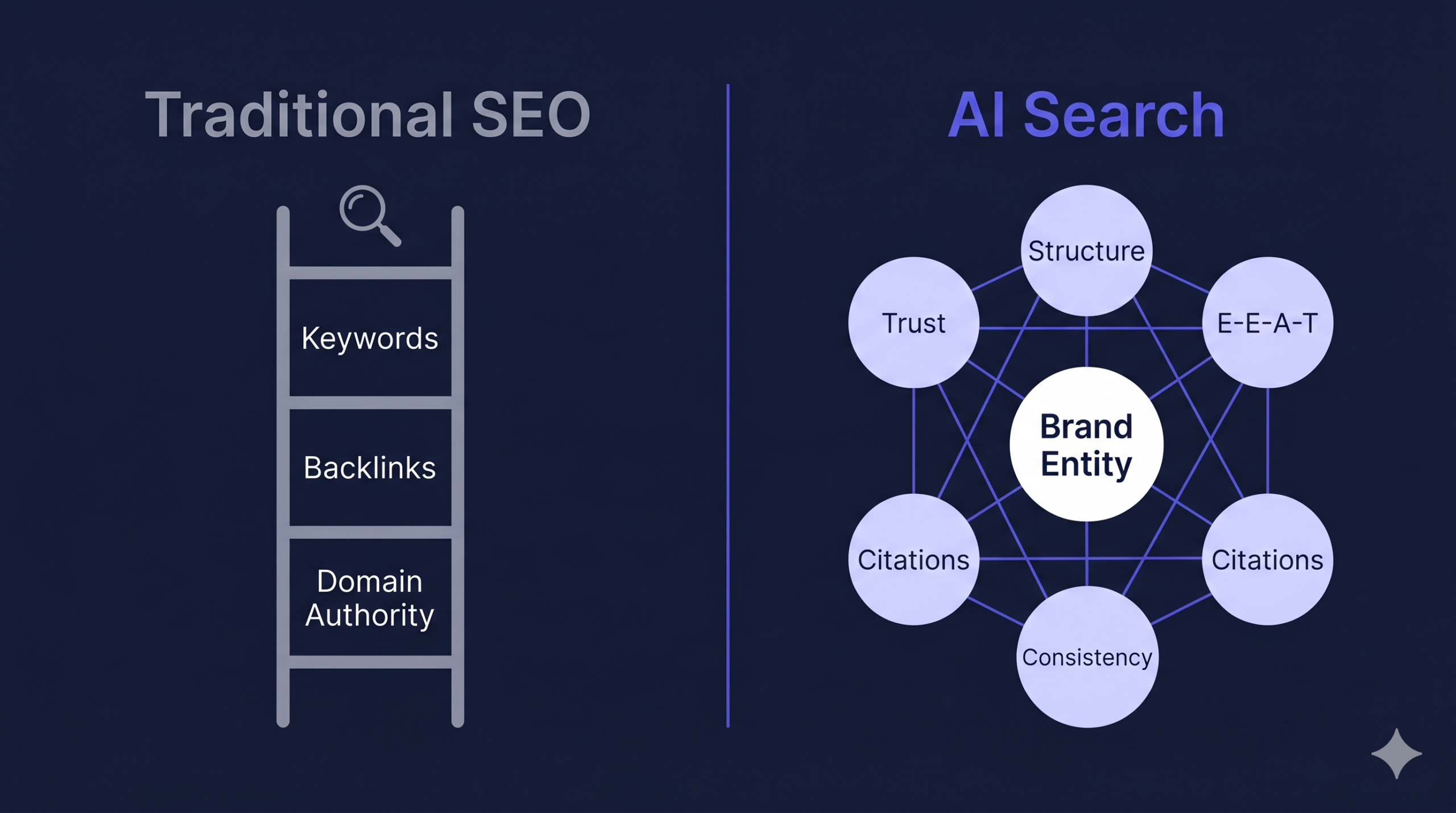
Ranking in AI search engines means building a brand that AI systems recognise as a credible, trustworthy entity worth citing, not simply optimising a page for keywords. The businesses appearing in ChatGPT, Perplexity, and Google AI Overviews have done four things consistently: structured their content for extraction, built consistent entity signals across platforms, removed technical barriers to AI crawling, and earned third-party mentions AI tools use to verify credibility.
What this guide covers:
Trust over keywords: AI systems evaluate source credibility and entity consistency before including any brand in an answer.
Entity recognition: Your brand must appear consistently across your website, social profiles, directories, and publications for AI tools to verify it.
Question-format content: AI Overviews appear on 57.9% of question-based queries — content structured as direct answers to questions earns citations far more reliably than general topic posts.
Structured content formats: Definition-first openings, self-contained FAQ sections, and named frameworks are the formats AI tools cite most consistently.
E-E-A-T signals: Author credentials, cited data, and first-person expertise signal to AI systems that your content is safe to reference.
Technical access: GPTBot and PerplexityBot must not be blocked in your robots.txt file or your entire site is invisible to those engines.
Topical authority: A cluster of interlinked posts on one subject signals more authority to AI systems than any single well-optimised standalone page.
Content freshness: Regularly updated content with new data and statistics signals relevance and improves citation frequency across AI platforms.
This post covers the specific changes that get a business cited in ChatGPT, Perplexity, and Google AI Overviews starting with the ones that can be made this week.
Why Does Query Type Determine Whether AI Overviews Appear?
Not every search triggers an AI Overview. Understanding which query types do is the first step to targeting the right content.
• Question-based queries dominate AI Overview triggers
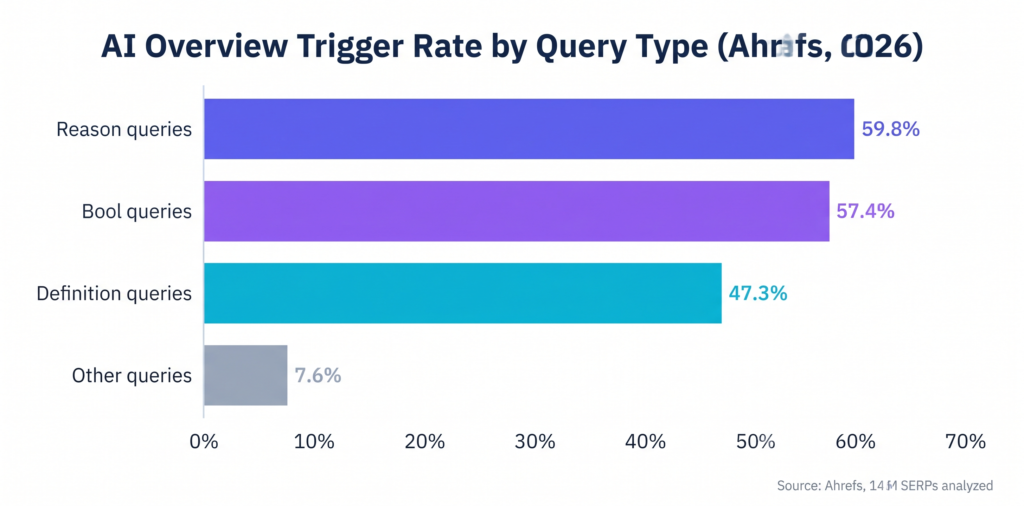
According to Ahrefs’ analysis of 146 million SERPs, AI Overviews appear on 57.9% of question-based queries compared to just 15.5% of non-question queries. “Why” queries trigger AI Overviews at the highest rate of all — 59.8% of the time. “Yes/no” queries follow at 57.4% and definition queries at 47.3%.
The practical implication is that content framed as a direct answer to a specific question is significantly more likely to earn an AI citation than general topic content.
• Long-tail queries are more likely to trigger AI responses
Ahrefs’ data also shows that queries with seven or more words trigger AI Overviews 46.4% of the time, compared to just 9.5% for single-word queries. This means the more specific and conversational your target keywords, the more likely a searcher will encounter an AI Overview — and the more important it becomes to be the cited source in that answer.
A marketing consultant searching “how do I get my business to show up in ChatGPT answers” is far more likely to see an AI Overview than one searching “AI search.”
• Informational intent is the only intent that consistently earns citations
Ahrefs found that 99.9% of AI Overview keywords carry informational intent. Commercial and transactional queries almost never trigger AI Overviews. This does not mean BOFU content is worthless — it means the path to AI citations runs through informational content that warms up the reader before they ever reach your service pages. Generative engine optimization for businesses covers how to build that informational content layer systematically.
What Content Structure Do AI Tools Actually Cite?
Both Ahrefs and SE Ranking agree on the principle: structured content earns more citations. Here is what that means in practice for each content element.
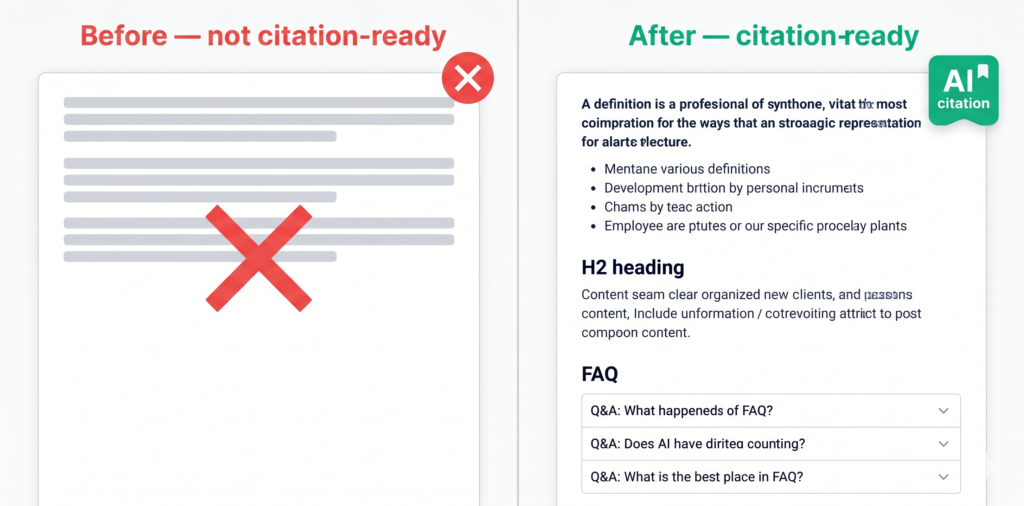
• Definition-first openings pull into AI Overviews
The first 60 words of every page determine whether AI tools extract it as an answer. Pages that open with a direct, self-contained definition of the core topic earn citations far more frequently than pages that build to the point over three introductory paragraphs.
If your first sentence cannot stand alone as a complete answer to the query that brought someone to the page, rewrite it before doing anything else. This is the single structural change with the highest citation impact per minute of effort.
• FAQ sections are the highest-cited content format
In almost every content audit we run at Tabula, the FAQ section is the first element AI tools pull from a page. SE Ranking’s research confirms that pages appearing in Google’s People Also Ask boxes — which share the same Q&A structure as FAQ sections — have a significantly higher likelihood of being included in AI Overviews.
Each FAQ answer must be fully self-contained, between 60 and 80 words, written in plain prose, and readable without surrounding context. That format is what AI systems trust enough to cite verbatim. What is E-E-A-T covers the trust signals that determine whether that FAQ content gets surfaced.
• Named frameworks get cited, unnamed processes get paraphrased
Content that names a specific concept or method earns citations. Content that describes a generic process gets absorbed and rewritten by the AI without attribution. Naming your frameworks is a citation strategy, not a branding exercise.
A post about “The 4-Step Entity Trust Audit” earns citations where a post about “how to check your brand presence” does not.
• Semantic depth beats keyword repetition
Google’s BERT and RankBrain evaluate content for conceptual completeness, not keyword frequency. A post covering the related entities and concepts surrounding its main topic will rank for more queries and earn more citations than a post that repeats one phrase repeatedly.
Write about the full topic — the tools, the process, the outcomes, the common mistakes — not just the keyword phrase. How to get found in ChatGPT and Perplexity walks through the content restructuring process in detail.
What Technical Barriers Are Blocking AI Tools From Accessing Your Site?
Before any content optimisation matters, AI search engines need permission to crawl your site. Neither Ahrefs nor SE Ranking covers this — yet it is the most common reason businesses are invisible in AI search despite having strong content.
• Check your robots.txt file before doing anything else
Go to yourdomain.com/robots.txt right now. If you see “GPTBot: Disallow” or “PerplexityBot: Disallow,” your entire site is invisible to those AI engines regardless of how good your content is.
This file-level block is the most common technical barrier we find in AI search audits — and the easiest to fix. Remove the disallow rule, save the file, and the crawlers return within days. AI changing SEO covers how AI crawlers have changed the technical SEO landscape more broadly.
• NAP consistency across every platform matters for entity verification
Your business name, address, and phone number must match exactly across your website, Google Business Profile, LinkedIn, and directory listings. AI tools cross-reference these sources to verify entity credibility before citing a brand. A business listed as two slightly different names across platforms creates an entity mismatch that reduces citation confidence. Standardise every listing before optimising any content.
• Schema markup gives AI crawlers a structured briefing on your business
JSON-LD schema for Organisation, Service, and FAQ gives AI crawlers a direct, machine-readable summary of your brand and content. Without it, AI tools infer your business category from unstructured text and frequently deprioritise the page.
Adding schema to your homepage, service pages, and every FAQ section is the baseline technical implementation that both Google and AI engines reward. If your site needs a structural rebuild to support this properly, Tabula’s web development services are designed specifically for businesses that need a schema-ready, conversion-optimised foundation.
How Do You Build the Authority Signals AI Systems Actually Trust?
Technical access and structured content get your site in the room. Authority signals determine whether AI tools are willing to cite you. These take longer to build — but the foundation can be laid this month.
• Topical authority clusters outperform isolated posts
SE Ranking identifies content clusters as one of its top strategies, and the data supports it. A single well-optimised post rarely earns consistent AI citations. A cluster of six to eight interlinked posts covering a topic from multiple angles signals far more authority to AI systems than any standalone page.
In our experience building content systems for clients, consistent AI citation frequency reliably begins after that cluster threshold is reached and the posts have been live long enough to be indexed together.
• Content freshness is a measurable citation signal
SE Ranking’s research highlights that regularly updated content with new data and statistics signals relevance and improves AI Overview inclusion rates. Practically, this means adding a “Last updated” date to your top posts, refreshing stats annually, and expanding sections when new research becomes available.
A post updated in the last 90 days earns citations more reliably than an identical post left static for 12 months. This applies to existing content, not just new posts.
• Third-party mentions build the cross-reference layer AI tools use
AI tools verify brand credibility by cross-referencing your presence across sources they already trust — industry publications, podcast mentions, niche directories, and LinkedIn activity. A business that exists only on its own website has no external signal for AI tools to cross-reference.
Guest articles, expert quotes in recognised publications, and consistent professional social presence each add a verification touchpoint. AI search visibility covers how to build this external signal layer systematically.
• Author credentials reduce the risk of citing your content
AI systems are built to avoid citing content they cannot verify as expert-led. An author byline with a clear credential, first-person experience signals inside the post (“In our audits we consistently find…”), and a linked author profile all reduce the perceived risk of citing your content.
Generic unattributed content gets paraphrased. Credentialed, specific, experience-backed content gets cited by name. At Tabula, author credential implementation is part of every content engagement because without it the content quality is invisible to AI systems. If you want to understand how we approach this, the about Tabula covers the Build → Run → Train → Own model in full.
Ranking in AI search engines in 2026 means becoming a trusted entity, not optimising a single page. The businesses appearing in ChatGPT, Perplexity, and Google AI Overviews have done three things consistently: structured their content for extraction, built cross-referenced authority across multiple platforms, and removed every technical barrier preventing AI crawlers from accessing their site.
The businesses invisible in AI answers are not producing worse content. They are producing content built for a search model that no longer controls discovery. According to Ahrefs’ data, AI Overviews now suppress click-through rates by 34.5% on the searches where they appear.
Not being cited in those answers is not neutral — it is a compounding disadvantage that widens every month. Tabula’s professional SEO and GEO services are built around exactly this — entity trust, structured content, and technical AI readiness working together.
If you want to know exactly where your business stands in AI search right now, Tabula’s free SEO and GEO audit gives you a clear picture of what AI tools can and cannot see, what to fix first, and what a full AI search visibility strategy looks like for your business.
Frequently Asked Questions
How do I know if my business is appearing in AI search engines?
The most direct way to check is to open ChatGPT with web browsing enabled, Perplexity, and Google with AI Overviews active, then search your core service category plus your city or niche. If your business name does not appear in any of the generated responses, you are not being cited. Run this check monthly — AI citation patterns shift as new content is indexed, entities are updated, and crawlers revisit your site after technical changes.
What is the difference between ranking in Google and ranking in AI search engines?
Ranking in Google means your page appears as a link in a list of search results. Ranking in AI search engines means your brand or content is cited as a source inside a generated answer. Google ranking is driven by page authority, keyword relevance, and backlinks. AI search ranking is driven by entity trust, content structure, and cross-referenced credibility signals. Both matter in 2026 and neither fully replaces the other, according to Ahrefs’ research on AI Overview behaviour.
How long does it take to start appearing in AI search engine answers?
Most businesses begin seeing AI citation improvements within 30 to 60 days of implementing the core structural and technical changes. Technical fixes — removing GPTBot disallow rules, adding schema markup, standardising NAP data — produce results within days. Content restructuring and authority building take longer to compound. Consistent topical cluster publishing over 60 to 90 days is typically when citation frequency becomes reliable and measurable across ChatGPT, Perplexity, and Google AI Overviews.
Does it cost money to rank in AI search engines like ChatGPT and Perplexity?
There is no paid placement in ChatGPT, Perplexity, or Google AI Overviews. Citations in those systems are entirely editorial decisions based on entity trust, content structure, and source credibility. The investment required is in content quality, technical setup, and authority building — not advertising spend. This is one of the primary reasons businesses that invest in how to rank in AI search engines now will hold a compounding advantage over competitors who rely exclusively on paid channels.
What technical changes do I need to make to rank in AI search engines?
Three technical changes have the highest immediate impact. First, remove any GPTBot or PerplexityBot disallow rules from your robots.txt file — this is the most common block we find and it makes the entire site invisible to those engines. Second, standardise your business name, address, and phone number across every platform and directory. Third, implement JSON-LD schema markup for Organisation, Service, and FAQ on your key pages. These three changes are the prerequisite layer for everything else.
Is traditional SEO still worth doing if AI search engines are taking over?
Traditional SEO remains essential in 2026. According to Ahrefs’ research, classic ranking signals including E-E-A-T, backlinks, page structure, and site speed now function as foundational inputs that AI search systems build their trust assessments on top of. A business that abandons traditional SEO to focus exclusively on AI search optimisation will find that both channels underperform. The correct approach is building both in parallel, with structured content that serves Google rankings and AI citation eligibility simultaneously.
FREE GEO + SEO AUDIT
You just read about how AI search engines decide who to cite. Now find out whether your business is passing that test.
Tabula has audited the AI search visibility of businesses across North America, identifying the exact gaps that keep brands invisible in ChatGPT, Perplexity, and Google AI Overviews.
Book a free 30-minute GEO + SEO audit with Tabula. You will walk away with:
- A clear picture of how AI tools currently see your brand and content
- The 3 highest-impact changes to make in the next 30 days
- A technical checklist covering robots.txt, schema, and entity consistency
- No obligation — if it is not a fit, you leave with a clear action plan regardless
Not ready to book? Explore Tabula’s professional SEO and GEO services →