
7 SEO Mistakes Small Business Owners Make That Are Quietly Killing Their Google Traffic

Most small businesses have a website. Far fewer have one that Google actually sends people to.
That gap is not a mystery. According to WordStream, nearly 97% of all websites receive zero organic traffic from Google. Read that again. Not low traffic. Zero. And for small businesses operating without a dedicated marketing team or SEO budget, the reasons almost always come down to the same handful of avoidable mistakes.
The frustrating part is that most of these are not complex technical failures. They are structural habits, like targeting the wrong keywords, writing content without a system behind it, or ignoring how search is changing in the age of AI. Each mistake on its own costs you a handful of visitors a month. Together, they explain why your competitor with a worse product keeps showing up above you.
This post breaks down the seven most damaging SEO mistakes small business owners make, why each one matters more than ever in 2026, and exactly what to do about it.
Mistake 1: Targeting Keywords That Are Too Broad to Win
The most common SEO mistake small businesses make is also the easiest to understand: they target keywords that are simply too competitive.
A local accountant optimises their homepage for “accounting services.” A physiotherapy clinic writes blogs about “back pain.” A marketing consultant targets “social media marketing.” These are not bad topics. They are bad bets. Those keywords are dominated by national brands, directories, and high-authority publishers who have spent years earning their rankings. A small business trying to rank for them is like entering a marathon without training.
The fix is specificity. Long-tail keywords, meaning phrases of three to five words or more that reflect exactly what a searcher is looking for, convert better and compete at a fraction of the difficulty. “Accounting services for freelancers in Bristol” is not just more winnable. It is a more qualified search, meaning the person who types it is far closer to becoming a client.
Start with your Google Search Console data. Look at which queries you are already appearing for, even if you are ranking on page two or three. These are your signals. A tool like Google’s free Keyword Planner or a paid alternative like Ahrefs or Semrush will show you keyword difficulty alongside search volume, so you can identify terms worth actually chasing.
You can also read Tabula’s guide on how to do keyword research for your small business for a practical framework to start from scratch.
Mistake 2: Writing Content Without a System Behind It
Publishing a blog post every few weeks and hoping it ranks is not a content strategy. It is content chaos. And Google’s ability to reward topical authority means that scattered content now actively works against you.
Here is what this looks like in practice: a small business publishes three or four standalone blog posts with no clear relationship to each other, no internal linking structure, and no pillar page tying the topic together. Each post exists in isolation. Google does not know what your site is fundamentally about, so it does not rank it for anything in particular.
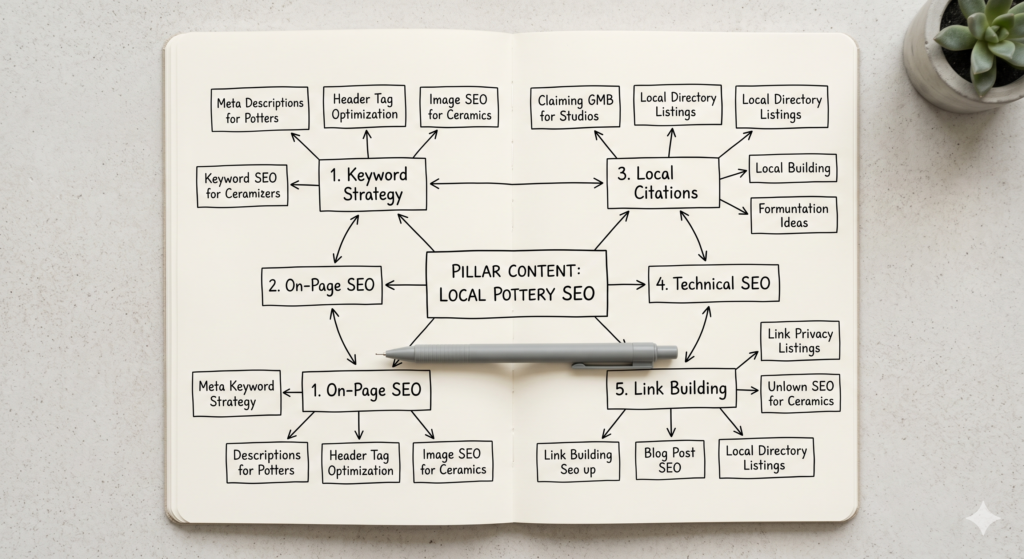
Topical authority is built when your site demonstrates deep, interconnected knowledge of a specific subject. That means writing pillar pages (comprehensive, 2,000-plus word guides on a core topic) and then building cluster content around them. Each cluster post links back to the pillar. Each pillar links out to the clusters. This architecture tells Google: this site is genuinely expert on this subject.
For a small business, this does not mean publishing daily. It means publishing with intention. Four well-structured, interlinked posts per month on a single topic cluster will outperform twelve random posts every time.
If you want to understand how AI-powered content systems make this sustainable without requiring a full-time content team, this breakdown of AI marketing for small businesses is worth reading.
Mistake 3: Ignoring Technical SEO Basics
You can write excellent content and still rank nowhere if the technical foundations of your site are working against you. This is one of the most quietly damaging mistakes small businesses make because the problem is invisible until you specifically look for it.
The core technical issues that routinely suppress small business rankings include:
Slow page speed. Google has used page experience as a ranking factor since 2021. A site that takes more than three seconds to load on mobile is a site that loses visitors before they even read a word, and Google knows it. Run your site through Google’s PageSpeed Insights. If your scores are below 70 on mobile, that is a problem worth fixing now.
Missing or duplicate title tags and meta descriptions. Every page on your site needs a unique, keyword-informed title tag under 60 characters and a meta description under 155 characters. These are not just SEO signals; they are the copy that determines whether someone clicks through from search results at all. If two pages share the same title tag, Google cannot tell them apart.
No schema markup. Structured data tells search engines what your content means, not just what it says. Adding FAQ schema, Article schema, or HowTo schema where relevant increases your chances of appearing in rich results, including the coveted “People Also Ask” boxes and AI Overviews.
Broken internal links and crawl errors. Google cannot rank pages it cannot find or access. A quick crawl with a tool like Screaming Frog (free up to 500 URLs) will surface broken links, redirect chains, and pages that have accidentally been blocked from indexing.
The good news is that a one-time technical audit, followed by a quarterly check-in, is enough to stay on top of most of these issues. Tabula’s post on AI SEO audits walks through how to run one efficiently.
Mistake 4: Producing Thin Content That Has Nothing New to Say
Not all content is equal to Google, and in 2025, the gap between content that ranks and content that does not has never been wider.
Thin content means posts that cover a topic at surface level, essentially restating what already exists rather than adding genuine value, expertise, or perspective. A 400-word blog post that describes what SEO is in general terms is not content Google will reward. It is content that dilutes your site’s overall authority.
Google’s E-E-A-T framework, which stands for Experience, Expertise, Authoritativeness, and Trustworthiness, is the lens through which quality content is now assessed. This means that the content most likely to rank is content that shows firsthand experience, specific data, named examples, and a clear point of view. You can read a full breakdown of what E-E-A-T means and how to demonstrate it for more context.
For small business owners, this is actually an advantage. You have direct knowledge of your industry, your clients’ problems, and your own results that no generalist content factory can replicate. The mistake is not using it. Write from experience. Include specific examples from your own business. Reference real outcomes. Name the frameworks you actually use. This is the signal that separates genuine expertise from content that is just filling a word count.
Content depth matters too. Research consistently shows that comprehensive posts in the range of 1,500 to 2,500 words tend to outperform shorter, thinner alternatives for competitive keywords. That does not mean padding. It means covering the topic properly.
Mistake 5: Treating SEO and GEO as Separate Concerns
If your SEO strategy does not account for how AI tools surface and recommend content, it is already out of date.
Google’s AI Overviews now appear in nearly half of all search results, according to WordStream. Platforms like Perplexity, ChatGPT, and Gemini are increasingly where people go to find information, recommendations, and service providers. These tools do not just index your content; they cite it (or do not) based on how well-structured, authoritative, and definitional it is.
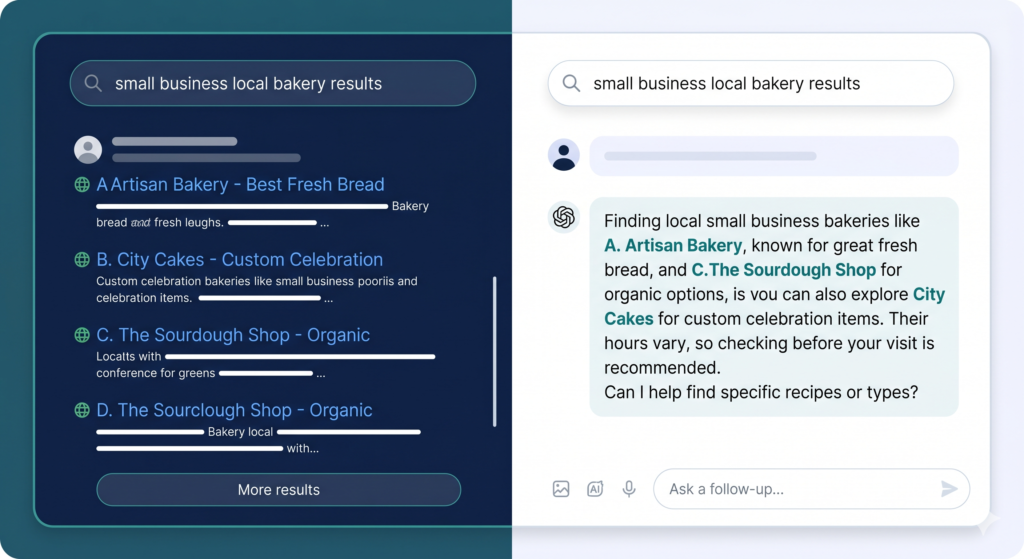
Generative Engine Optimisation (GEO) is the practice of structuring content so it earns citations in AI-generated answers, not just rankings in traditional search results. It is not a replacement for SEO. It is an extension of it. And for small businesses, getting ahead of this curve now is the equivalent of building a website in 2005 while competitors were still in the phone book.
The structural requirements for GEO are actually well-aligned with good SEO: clear definitions at the top of each piece, named frameworks and proprietary concepts, FAQ sections answering real “People Also Ask” queries, and first-person expertise signals throughout. The difference is intentionality. You are writing not just to rank, but to be cited.
Tabula has written a practical guide on Generative Engine Optimisation for small businesses that covers the specific structural elements that increase citation probability. It is worth bookmarking before you write your next piece of content.
You can also get found in tools like ChatGPT and Perplexity by following the principles in this guide on getting discovered in AI search.
Mistake 6: Neglecting the Website Experience That SEO Sends People To
This is the mistake that makes the other six even more damaging. You optimise, you rank, you get the click. And then your website loses the visitor in fifteen seconds.
Google measures this. Bounce rate, time on site, and pages per session are all behavioural signals that feed back into how Google assesses whether your content deserved that ranking in the first place. A page that earns clicks but fails to engage visitors signals to Google that the result was not useful, and rankings fall accordingly.
For small businesses, the most common site experience issues that undermine SEO are:
A homepage that does not immediately tell visitors what you do, who you do it for, and what they should do next. If someone lands on your site and has to scroll past a hero image of stock photography and a vague tagline to work out what you sell, you have already lost them.
Landing pages that do not match the intent of the search that brought someone there. If you rank for a specific service keyword but your landing page is a generic services overview, the mismatch between what someone expected and what they found increases abandonment. There is a full guide on landing pages that convert if this is an area worth tightening up.
A site that is not built for mobile. Over 60% of all website traffic now comes from mobile devices. If your site requires pinching and zooming, loads slowly on 4G, or has buttons too small to tap accurately, you are actively handing traffic to competitors. Google’s mobile-first indexing means it evaluates your mobile experience first when determining rankings.
SEO gets people to the door. Your website has to earn the rest.
Mistake 7: Expecting Results Without a System or a Timeline
This is perhaps the most honest section of this post, and the most important for small business owners to hear.
SEO is not a campaign. It is not something you do for three months and then stop. It is a compounding system, meaning the work you do today creates assets (rankings, authority, backlinks, indexed content) that continue generating returns months or years from now, without additional spend. But it requires patience that most small businesses are not conditioned to extend to marketing.
The reality is that new content typically takes three to six months to begin gaining meaningful traction in search results. Technical fixes can show impact faster, but content-driven authority is a long game by design. The businesses that win at SEO are not the ones who spent the most in any given month. They are the ones who stayed consistent.
The second part of this mistake is running SEO without a system behind it. Posting sporadically, conducting keyword research once and never revisiting it, or treating SEO as a standalone effort disconnected from the rest of your marketing means each effort starts from scratch rather than building on what came before.
What separates small businesses that grow through organic search from those that do not is almost always structure. A documented content plan, a clear internal linking strategy, monthly review of Google Search Console data, and consistent execution beats the best one-off piece of content every single time. If you want to understand what a structured AI marketing system looks like for a business without a full marketing team, that piece is a good place to start.
Frequently Asked Questions
How long does SEO take to work for a small business?
Most SEO improvements take between three and six months to show measurable results in search rankings. Technical fixes like resolving crawl errors or improving page speed can have faster impact, sometimes within weeks. Content-driven authority, which comes from consistent publishing and internal linking, compounds over time and typically matures between six and twelve months after launch.
What is the most important SEO factor for small businesses?
There is no single factor, but keyword targeting is the foundation everything else builds on. If you are targeting terms you cannot realistically rank for, or terms that do not match the intent of people likely to become your customers, no amount of technical optimisation or content quality will produce results. Get your keyword strategy right before investing heavily in anything else.
Is SEO still worth it for small businesses in 2026?
Yes, and more so than in previous years. Organic search still accounts for more than 50% of all trackable website traffic. While AI Overviews and zero-click results have changed what ranking looks like, the businesses that are structured for both traditional SEO and Generative Engine Optimisation (GEO) are earning citations, visibility, and trust across every discovery surface. The businesses ignoring it are growing harder to find.
What is GEO and why does it matter for small businesses?
GEO stands for Generative Engine Optimisation. It refers to structuring your content so it earns citations in AI-generated answers from tools like Google’s AI Overviews, ChatGPT, and Perplexity. As more people use AI tools to find service providers and information, appearing in those answers matters as much as appearing on page one of Google. The two are closely related but require slightly different content structures.
Can I do SEO myself as a small business owner?
Yes, particularly at the foundational level. Setting up Google Search Console, claiming your Google Business Profile, conducting basic keyword research, and ensuring your on-page fundamentals (title tags, meta descriptions, headers) are in order are all things you can handle without an agency. Comprehensive SEO, including technical audits, content strategy, and link building, benefits from specialist knowledge and consistent execution that most business owners are better served by delegating.
These seven mistakes are not exotic or obscure. They are the default state of most small business websites because SEO is treated as a one-time task rather than a compounding system.
The businesses that consistently win in organic search do one thing differently: they treat SEO as infrastructure, not maintenance. They build it into how they publish, how they structure their site, and how they think about content. Every piece earns its place and connects to something else.
If your website is not generating the organic traffic your business needs, one or more of these mistakes is almost certainly the reason. The good news is that each one has a clear fix, and fixing them does not require an enterprise budget. It requires a plan.
Not sure where your SEO is losing you traffic? Tabula offers a free AI Marketing System Audit, a 30-minute session that maps your current setup, identifies the specific gaps costing you organic visibility, and shows you exactly what to prioritise first.
Book your free audit at Tabula and find out what is standing between your website and the traffic it should already be getting.