
What Is an AI Marketing System? The Definitive Guide for Small Businesses

An AI marketing system is a connected framework of tools, automation, content, and strategy that works together to attract, nurture, and convert customers without requiring you to manually manage every piece.
That definition matters right now because small businesses are drowning in marketing complexity. There are more tools available than ever, more channels demanding attention, and more noise to cut through. Yet most small business owners are seeing less return per marketing dollar, not more.
At Tabula, we build AI marketing systems for small businesses connecting content, SEO, GEO, automation, and lead generation into one owned system that runs without agency dependency.
This guide breaks down exactly what an AI marketing system is, why your business needs one in 2026, what it’s made of, and how to start building one. Even if you have a small team and a tight budget.
If you’ve ever felt like your marketing is just a pile of disconnected tools that eat your time and budget, you’re not alone. That’s not a marketing problem. That’s a system problem.
What Is an AI Marketing System? (The Simple Version)
Here’s the clearest way to think about it.
Most small businesses approach marketing like this: they post on Instagram when they remember, send an email newsletter twice a year, run a Google Ad when sales slow down, and pay an agency to “do SEO.” Each piece is separate. Nothing talks to anything else. And when the owner gets busy, the marketing stops.
AI Marketing System (definition): An AI marketing system is an integrated set of AI-powered tools, automated workflows, and strategic content processes that consistently attracts leads, nurtures prospects, and drives sales. It runs largely on autopilot, without requiring constant manual input from the business owner.
An AI marketing system is different from “using AI tools.” Buying ChatGPT and Canva doesn’t give you a system any more than buying a hammer and some nails gives you a house. The tools are components. The system is what connects them with strategy, sequencing, and automation.
Think of it like the difference between owning a car and calling an Uber every time you need to go somewhere. Both get you there. But one you own, control, and can rely on anytime. The other depends on someone else showing up.
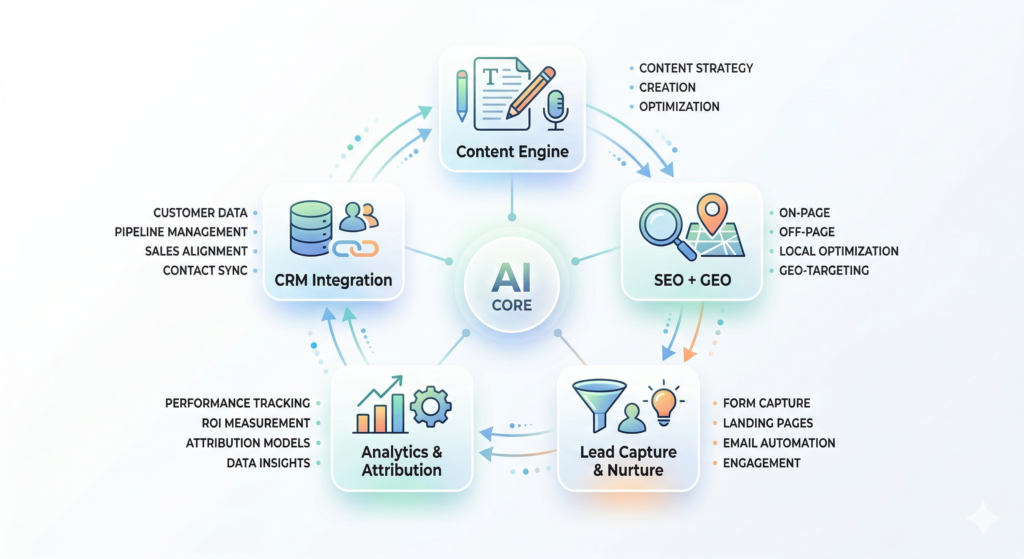
A complete AI marketing system for small business typically includes:
- A content engine: consistent blog, social, and email output powered by AI
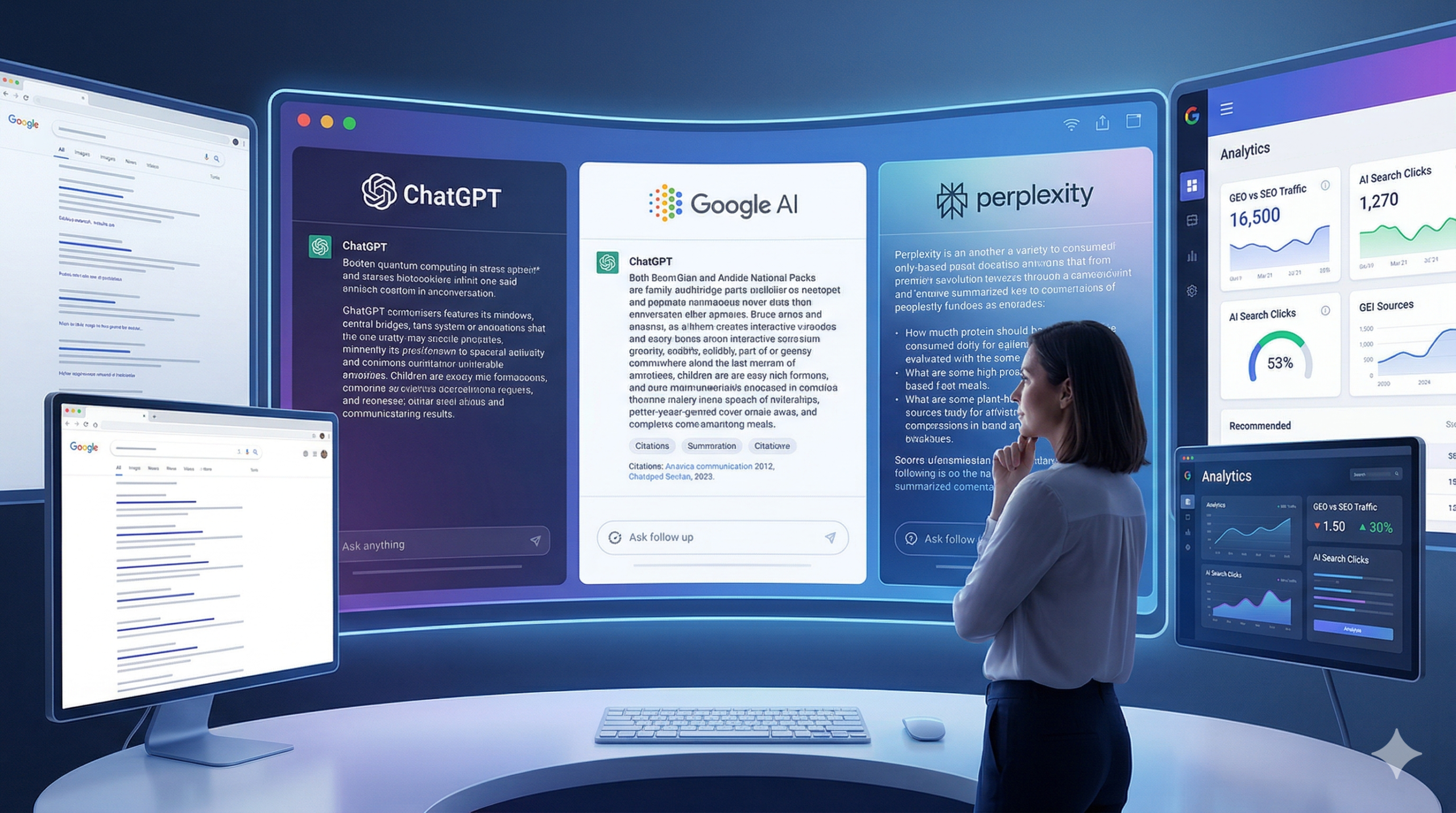
- An SEO and GEO layer: getting found on Google and in AI tools like ChatGPT and Perplexity
- Lead capture and nurture automation: so prospects don’t fall through the cracks
- Analytics and attribution: knowing what’s actually driving revenue
Why Do Small Businesses Need an AI Marketing System in 2026?
This is the question small business owners ask most: “Is this actually for me, or is this enterprise stuff?”
It’s for you. Here’s why.
The old way of marketing looked like this: hire an agency for $4,000 a month, get a monthly report full of impressions and traffic numbers, and wonder whether any of it was actually bringing in customers. Or do it yourself — spend 12 hours a week posting, writing, and responding — and still feel like you’re getting nowhere.
An AI marketing system for small business solves three specific problems:
Time. The average small business owner spends 8 to 12 hours per week on marketing tasks that could be automated or AI-assisted. That’s more than a full workday, every week, on tasks a system can handle.
Cost. Traditional marketing agencies charge between $2,500 and $8,000 per month, often without guaranteeing results or giving you ownership of what they build. When you stop paying, the marketing stops.
Consistency. This is the biggest one. Most small business marketing is inconsistent because it depends entirely on the owner’s energy and availability. AI marketing systems run whether you’re on vacation or buried in operations.
According to the U.S. Chamber of Commerce, 58% of small businesses now use generative AI in some capacity — up from 40% in 2024. The gap between businesses with systems and businesses without is widening fast.
The businesses growing fastest right now aren’t the ones with the biggest budgets. They’re the ones with the best systems.
The 5 Core Components of an AI Marketing System
1. Content Engine
Your content engine is the foundation of everything else. It’s the system that produces consistent blog posts, social content, and emails — without you writing every word from scratch.
AI tools can generate first drafts, repurpose blog posts into social content, and suggest topics based on what your audience is searching for. The key is building a repeatable workflow, not a one-off process.
What it looks like for a real SMB: A plumbing company publishes one keyword-optimized blog post per week, automatically repurposed into three Instagram posts and one email to their list — all drafted by AI and approved by the owner in 20 minutes.
2. SEO + GEO Layer
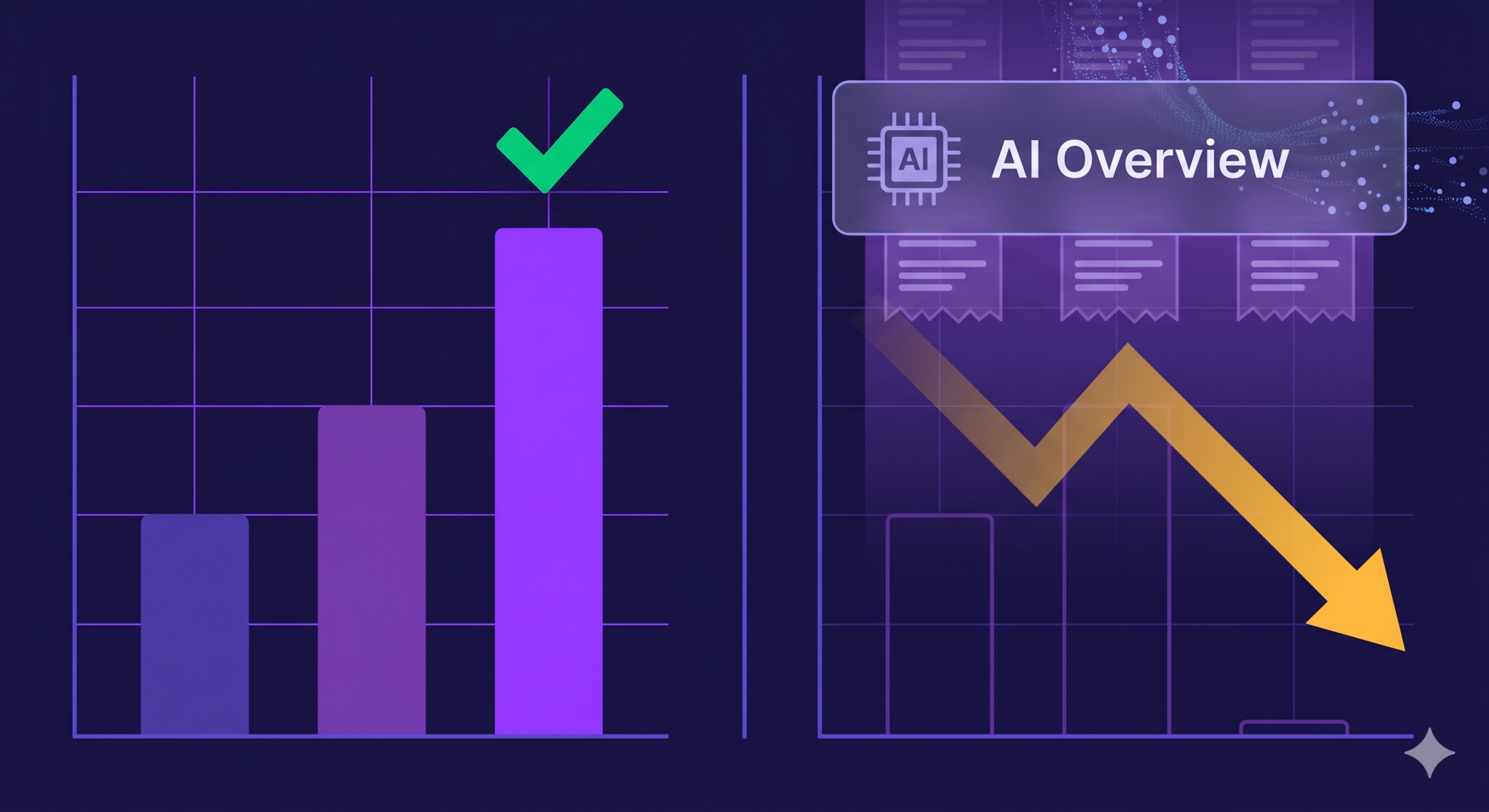
SEO (search engine optimization) gets you found on Google. GEO — Generative Engine Optimization — gets you cited in AI tools like ChatGPT, Perplexity, and Google’s AI Overviews. Both matter now. A complete AI marketing system optimizes for both simultaneously.
GEO works by structuring your content so AI tools can easily extract, understand, and cite it. That means clear definitions, named frameworks, FAQ sections, and structured headers.
What it looks like for a real SMB: A bookkeeper’s website starts appearing in ChatGPT answers when someone asks “how do I find a bookkeeper for my small business” — driving inbound leads without paying for ads.
3. Lead Capture and Nurture
Attracting visitors means nothing if they leave without converting. Your AI marketing system needs a clear lead capture mechanism (a landing page, a lead magnet, a contact form) and an automated email sequence that follows up without you lifting a finger.
What it looks like for a real SMB: A fitness studio offers a free “7-Day Meal Plan” PDF in exchange for an email. Anyone who downloads it gets a five-email sequence over two weeks, ending with an offer for a free trial class. This runs 24/7.
4. Analytics and Attribution
You need to know which marketing activities are actually driving revenue — not just which ones look busy. A solid AI marketing system connects your website, email, CRM, and ad platforms so you can see the full customer journey.
What it looks like for a real SMB: A law firm can see that 70% of their new client inquiries come from two blog posts — which tells them exactly where to invest more content effort.
5. CRM Integration
Your CRM is the connective tissue of your marketing system. It holds contact records, tracks lead status, triggers automations, and ensures nothing falls through the cracks. Without it, everything else is a disconnected island.
What it looks like for a real SMB: Every new lead from any channel — website form, Instagram DM, Google ad — flows automatically into HubSpot, gets tagged with a source, and triggers a specific follow-up sequence based on how they found you.
The 4 Stages of AI Marketing Maturity
After working with dozens of SMBs, we’ve mapped out a consistent progression.
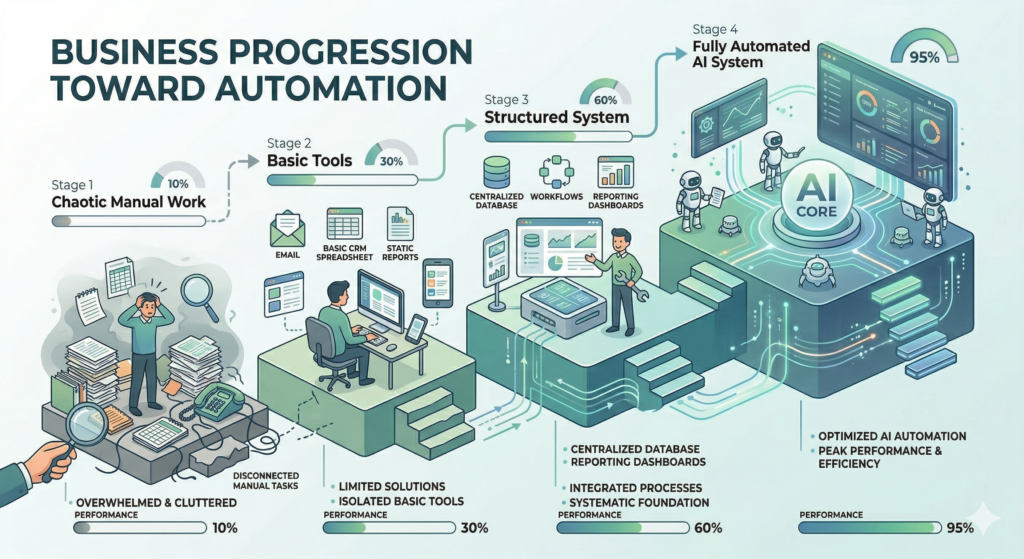
Stage 1 — Scattered Random tools, no strategy, the owner does everything manually. Marketing happens in bursts when there’s time. There’s no system — just effort.
Stage 2 — Structured Basic website, some content, maybe one tool like Mailchimp or HubSpot, but nothing talks to anything else. Marketing is happening, but it’s disconnected and inconsistent.
Stage 3 — Systematic Content engine running, SEO in place, leads being captured and followed up automatically. Marketing happens whether or not the owner is in the room.
Stage 4 — Self-Sufficient Full AI marketing system running with minimal owner input. All marketing assets — website, content, ad accounts, CRM — are owned by the business, not an agency. The system compounds over time.
Most SMBs we work with start at Stage 1 or 2. The goal of a Tabula engagement is to move you to Stage 3 or 4 — and hand you the keys when we’re done.
How to Build an AI Marketing System for Your Small Business (Step-by-Step)
Step 1: Audit your current marketing. List every tool you’re paying for and every channel you’re active on. Be honest about what’s working and what’s just costing time. Most SMBs discover they’re paying for 4–6 tools they barely use.
Step 2: Define your core offer and ideal customer clearly. Before building anything, you need clarity on who you’re selling to and what you’re selling. AI amplifies your direction — if the direction is wrong, AI makes it worse faster.
Step 3: Choose your content engine. Pick one blog, one social channel, and email. Not six channels. The goal is consistency on a few things, not mediocrity everywhere. AI tools can help you produce 3x more content at the same time.
Step 4: Set up lead capture. Build one landing page with one clear offer. Connect it to a simple 3–5 email welcome sequence. This alone will outperform most SMB marketing setups.
Step 5: Connect your CRM and analytics. Make sure every lead flows into one place and every action is tracked. You can’t improve what you can’t measure.
Step 6: Add AI tools to accelerate each layer. Use AI for content drafting, scheduling, SEO research, and reporting — not to replace strategy, but to execute it faster and at higher volume.
Step 7: Review and optimize monthly. Look at what’s working and double down. Cut what isn’t. Systems compound over time — a 10% improvement each month adds up fast over a year.
Common Mistakes Small Businesses Make When Building AI Marketing Systems
Mistake 1: Buying tools instead of building a system. HubSpot doesn’t help you if you don’t know what to send. Jasper doesn’t help you if you don’t have a content strategy. Tools without a system are just monthly subscriptions draining your budget.
Mistake 2: Trying to be on every channel. Posting on LinkedIn, Instagram, TikTok, Facebook, and X — with a team of two people — produces nothing on all channels. Pick one or two and do them well.
Mistake 3: Skipping the strategy layer. AI can write your content, schedule your posts, and respond to leads. But it can’t tell you who your customer is or what you actually stand for. Strategy comes before automation.
Mistake 4: Outsourcing ownership. If your agency disappeared tomorrow, would you still have your website, your content, your ad accounts, your email list? You should. Never let a vendor own your marketing assets.
Mistake 5: Measuring vanity metrics. Follower counts and post impressions don’t pay invoices. Measure leads, conversion rates, and revenue attribution. Everything else is noise.
How Much Does an AI Marketing System Cost?
Here’s the honest breakdown across three paths:
DIY with AI tools: $100–$500/month in tool costs, plus 10+ hours per week of your time. Viable if you enjoy marketing and can commit the hours. Most business owners burn out within 60 days.
Traditional marketing agency: $2,500–$8,000+/month. Often no ownership of assets. Results vary widely. When you stop paying, the marketing stops — and sometimes so does your access to your own accounts.
AI-powered agency (like Tabula): Built as a system you own. Tabula’s model is Build → Run → Train → Own. We build your marketing system, run it until it’s optimized, train your team to operate it, and then hand it over. You’re not renting marketing — you’re building an asset.
The real cost of not having a system isn’t the money — it’s the compounding missed growth every month your marketing stays inconsistent.
Is an AI Marketing System Right for Your Business?
Answer these five questions honestly:
- [ ] Do you spend more than 5 hours per week on marketing with inconsistent results?
- [ ] Are you dependent on an agency or freelancer who controls your accounts?
- [ ] Do you struggle to measure which marketing activities actually drive revenue?
- [ ] Is your website generating less traffic than it did 12 months ago?
- [ ] Do you want to eventually own and run your own marketing without paying a retainer forever?
If you said yes to two or more of these, an AI marketing system is worth exploring.
An AI marketing system isn’t a single tool — it’s a connected framework of content, automation, SEO, and analytics working together consistently. For small businesses, it replaces the inefficiency of hiring a full agency or juggling twelve disconnected apps. The businesses winning in 2026 aren’t the ones spending the most on marketing. They’re the ones with the best systems.
Ready to find out where your marketing system stands?
Tabula offers a free AI marketing audit — we’ll review your current setup, identify the biggest gaps, and show you exactly what a system would look like for your business. No obligation, no sales pressure.
Frequently Asked Questions
What is an AI marketing system for small business?
An AI marketing system for small business is an integrated framework that uses artificial intelligence to automate and connect content creation, SEO, lead generation, email nurturing, and analytics. Unlike individual AI tools, a system connects all these pieces so they work together continuously — attracting and converting customers without requiring the business owner to manually manage every task.
How is an AI marketing system different from AI marketing tools?
AI marketing tools are individual applications — a content writer, a scheduling tool, an email platform. An AI marketing system connects those tools with strategy, automation, and a clear workflow so they operate as a single engine. Tools are components. A system is what makes them useful. Most small businesses own the tools but haven’t built the system.
How long does it take to build an AI marketing system?
A basic AI marketing system — content engine, lead capture, CRM integration, and analytics — can be operational in 30–60 days. A fully optimized system with SEO traction and automated nurture sequences typically takes 90–120 days to show meaningful results. The key is building in the right sequence: strategy first, then foundation, then acceleration.
Can a small business run an AI marketing system without a team?
Yes. Many solopreneurs and businesses with 2–5 employees run effective AI marketing systems. The goal of AI is to give a small team the output of a much larger one. With the right tools and workflows in place, one person can manage a content engine, lead funnel, and CRM that previously required a team of three or four.
What is the difference between an AI marketing agency and a traditional marketing agency?
A traditional marketing agency typically manages your marketing on a retainer — they own the strategy, the tools, and often your accounts. When you stop paying, the work stops. An AI marketing agency like Tabula builds a system that the client owns. Tabula’s model — Build → Run → Train → Own — means the goal is always to transfer ownership to the client, not create dependency.
What is GEO and why does it matter for small business marketing?
GEO stands for Generative Engine Optimization — the practice of structuring your content so AI tools like ChatGPT, Perplexity, and Google’s AI Overviews can find, understand, and cite it. As more people search using AI tools instead of traditional Google searches, GEO is becoming as important as SEO. Small businesses that optimize for GEO now will have a significant visibility advantage in the next 12–24 months. Learn more about GEO on the Tabula blog.
How do I know if my business is ready for an AI marketing system?
If you’re generating at least some revenue, have a defined product or service, and know roughly who your customers are — you’re ready. You don’t need a big team or a big budget. What you need is clarity on your offer and a willingness to invest in a system rather than one-off tactics. The businesses that aren’t ready are the ones that haven’t yet decided what they’re selling or who they’re selling to.
What does Tabula do differently from other marketing agencies?
Tabula builds AI marketing systems that clients own outright. Most agencies create dependency — when you stop paying, the marketing stops. Tabula’s Build → Run → Train → Own model means every engagement ends with the client in full control of their marketing system, assets, and strategy. We measure success by how little you need us over time, not how much. Learn more about how Tabula works.