Instagram vs LinkedIn vs Facebook for Small Business: Which Platform Is Worth Your Time in 2026?

Most guides to this question read like a travel brochure. Instagram is great for visuals! LinkedIn is perfect for B2B! Facebook connects you with your community! All three are technically accurate. None of them tell you what actually matters: where does a small business with limited time and a real revenue target get a return on the hours it puts in?
The honest answer in 2026 is more uncomfortable than most marketing blogs will say. Facebook organic reach for business pages has collapsed to between 1% and 3% — meaning a page with 2,000 followers reaches, on a good day, 60 people per post. LinkedIn company page reach dropped 60–66% between 2024 and 2026, according to data published by Ordinal in January 2026. Instagram’s average post reach rate sits at 3–4% of followers and is still declining year-on-year, per Socialinsider’s 2025 benchmarks. The platforms have not changed their pitch. The underlying math has.
This post gives you a clear-eyed breakdown of each platform — what it actually delivers for small businesses in 2026, not what it delivered in 2021. By the end, you’ll know exactly which platform deserves your time based on your business type, your content capability, and your revenue goal.
Facebook organic reach is at 1–3% for business pages — essentially zero without paid spend. LinkedIn company page reach fell 60–66% in 2024–26, though personal profiles still outperform every other platform for B2B reach. Instagram delivers the strongest organic discovery for visual, B2C businesses through Reels. The right answer depends on three variables: who your customer is, what you can produce consistently, and whether you’re selling to businesses or consumers. Most small businesses should go deep on one platform rather than mediocre across three.
What Has Actually Changed on Social Media in 2026?
The most important context for any platform decision in 2026 is this: every major social network now operates as an advertising business first and a content distribution platform second. That shift did not happen overnight, but its effects are now impossible to ignore.
Facebook’s organic reach fell from 16% in 2012 to 1–3% today, a deliberate contraction driven by Meta’s revenue model, not algorithm error. Instagram, which once rewarded consistent posting, has fragmented its feed to surface content from accounts users don’t follow — meaning your posts now compete against Reels from national creators and sponsored content for the same finite feed space. LinkedIn has undergone its own version of this shift: company pages now reach just 2–5% of their followers on initial distribution, while personal profiles receive far better algorithmic treatment because they generate the kind of engagement that keeps users on the platform longer.
This does not mean social media has stopped working for small businesses. It means the strategy has to match the current reality, not the one from three years ago. If you have noticed why organic traffic is dropping across your channels more broadly, the same structural shift is at play — platforms and search engines alike are tightening the gap between organic visibility and paid distribution. The businesses generating consistent leads from social in 2026 are not posting more — they are posting smarter, in the right format, on the right platform, and for the right goal.
Instagram for Small Business in 2026: Where It Still Earns Its Place
Instagram remains the strongest platform for organic discovery among B2C businesses — but only if the business can produce video content consistently and targets an audience under 45.
With over 2 billion monthly active users and an algorithm that still surfaces strong Reels beyond a brand’s follower base, Instagram offers something Facebook no longer can: the genuine possibility of reaching people who have never heard of you. According to Instagram CEO Adam Mosseri’s 2024 statement at Meta’s developer conference, Reels remain the platform’s primary vehicle for organic growth. Static image posts, by contrast, now reach a fraction of what they did even two years ago.
The content formats that perform on Instagram in 2026 are specific: short-form vertical video (15–60 seconds), carousel posts that prompt saves rather than just likes, and Stories used for behind-the-scenes content that builds personal connection. What does not work is posting product photos twice a week and wondering why the follower count isn’t moving.
Instagram is the right call for your business if:
- You sell a product or service with a visual dimension — food, interiors, fitness, fashion, beauty, creative services
- Your target customer is primarily between 18 and 44
- You can produce short-form video content at least three times per week without it becoming a bottleneck
- Your goal is brand awareness and top-of-funnel discovery, not immediate lead generation
Instagram is the wrong call if:
- You sell to other businesses and your buyer is a decision-maker aged 40+
- Your content strength is writing, not visuals or video
- Your team cannot sustain three to five posts per week — the algorithm rewards consistency, and a sporadic account essentially does not exist on Instagram in 2026
One important caveat for small businesses evaluating Instagram: the platform’s link restrictions — clickable links are confined to the bio and Stories — make it materially harder to drive website traffic than either LinkedIn or Facebook. If your conversion goal is getting someone to a landing page or a contact form, Instagram creates friction that the other two platforms do not.
LinkedIn for Small Business in 2026: The B2B Platform With a Catch
LinkedIn is the most powerful channel available to B2B small businesses in 2026 — but the version of LinkedIn that works is not the company page. It is the personal profile.
The distinction matters enormously. LinkedIn company page reach dropped 60–66% from 2024 to early 2026, according to Ordinal’s January 2026 analysis of the platform’s algorithm restructure. A company page post now reaches just 2–5% of its followers on initial distribution. Most small business owners have been posting on their company page, watching the numbers flatline, and concluding that LinkedIn does not work. The correct conclusion is that LinkedIn company pages have the same fundamental problem as Facebook business pages — they are not the mechanism through which the platform wants to distribute content.
Personal profiles, by contrast, receive 561% more reach than company pages on the same content, according to Ordinal’s 2026 data. LinkedIn’s algorithm has explicitly restructured itself around “knowledge transfer” — posts that share genuine professional insight, specific lessons from client work, or counter-intuitive takes on industry topics. According to Sales So’s 2026 data, multi-image carousel posts achieve 6.60% engagement rates on LinkedIn, native document posts achieve 6.10%, and video reaches 5.60%. Text-only posts from business accounts average 4.00% — still higher than Facebook’s median engagement of 0.2% for business pages in 2024, per Social Status benchmarks.
LinkedIn’s user base is where this platform earns its premium position. LinkedIn makes up over 50% of all social traffic to B2B websites and blogs, according to Wordstream’s 2026 platform analysis. There are 65 million decision-makers and 61 million senior-level professionals on the platform. For a small business whose ideal customer is a Head of Operations, a CFO, or a business owner in a specific vertical, no other platform concentrates that audience in the same place.
LinkedIn is the right call for your business if:
- You sell services or software to other businesses
- Your buyer is a professional, director, or business owner who uses LinkedIn actively
- You or a team member can consistently publish genuine thought leadership content — case studies, lessons learned, specific professional observations
- Your conversion goal is qualified lead generation or reputation-building in a defined professional niche
LinkedIn is the wrong call if:
- You sell directly to consumers and your customer does not use the platform in a professional capacity
- You plan to run the strategy through a company page only — without personal profile content from founders or team members, LinkedIn’s reach economics do not work in your favour
- You need rapid results: LinkedIn’s compounding authority model rewards consistency over six to twelve months, not six to twelve posts
For small businesses where the founder is the brand — consultants, agencies, coaches, professional service providers — LinkedIn personal profile content is the single highest-ROI organic social media activity available in 2026. The platform’s architecture rewards individual expertise in a way that has no equivalent on Meta properties.
Facebook for Small Business in 2026: Dead for Organic, Useful for Everything Else
Facebook is the most misunderstood platform in this comparison. Most small businesses either over-invest in it (posting daily on a business page to an audience of 800 followers, of whom 16 people see each post) or dismiss it entirely. Neither response is right.
Organic reach on Facebook business pages sits at 1–3% in 2026, down from 16% in 2012, according to data from Gray Reserve’s July 2025 analysis of Meta’s platform economics. This is not a recovery situation — Meta’s business model is built on the gap between organic and paid reach, and there is no incentive to reverse this trend. A business page with 1,000 followers posting organically is reaching 10–30 people per post. That is not a social media strategy. That is digital shouting into a void.
What Facebook does still provide for small businesses — and provides better than any other platform — is three specific use cases that are worth understanding.
The first is Facebook Groups. Building or participating in a community group relevant to your industry or local area generates warm, qualified attention at no cost. Unlike business pages, Groups are surfaces where the algorithm actively promotes discussion and participation. A local accountant who genuinely helps people in a “Small Business Owners in [City]” Facebook Group will generate more inbound leads per hour invested than any amount of business page posting.
The second is paid advertising. Meta’s ad platform, shared across Facebook and Instagram, remains the most accessible paid social option for small businesses. Geographic targeting lets a local service business reach people within a specific radius for a few pounds or dollars per day. The Facebook ad ecosystem is not organic social — it is a separate strategic question — but it is worth separating from the question of organic page reach, which is functionally dead.
The third is local discovery. Facebook still functions as a quasi-directory for local businesses — reviews, recommendations, and the “Recommendations” feature where community members ask for vetted suppliers in their area. Maintaining an accurate, active Facebook business profile has genuine local SEO and word-of-mouth value even if the organic content reach is negligible.
Facebook organic business pages are worth your time if:
- You are a local service business (trades, healthcare, childcare, hospitality) where community recommendation is a primary acquisition channel
- You have budget to run Facebook or Meta ads, and want to use the organic page as social proof infrastructure for those ads
- Your audience is primarily 35–65+ and is active on Facebook more than other platforms
Facebook organic business pages are not worth your time if:
- You are measuring success by post reach or follower engagement from the business page
- You are a B2B business — your buyers are not in purchase-intent mode on Facebook
- You are trading hours for organic reach on a platform where the economics guarantee diminishing returns
How to Choose the Right Platform: A Framework for Small Businesses
The three questions that determine your platform decision are simpler than most guides suggest. Every other consideration flows from these.
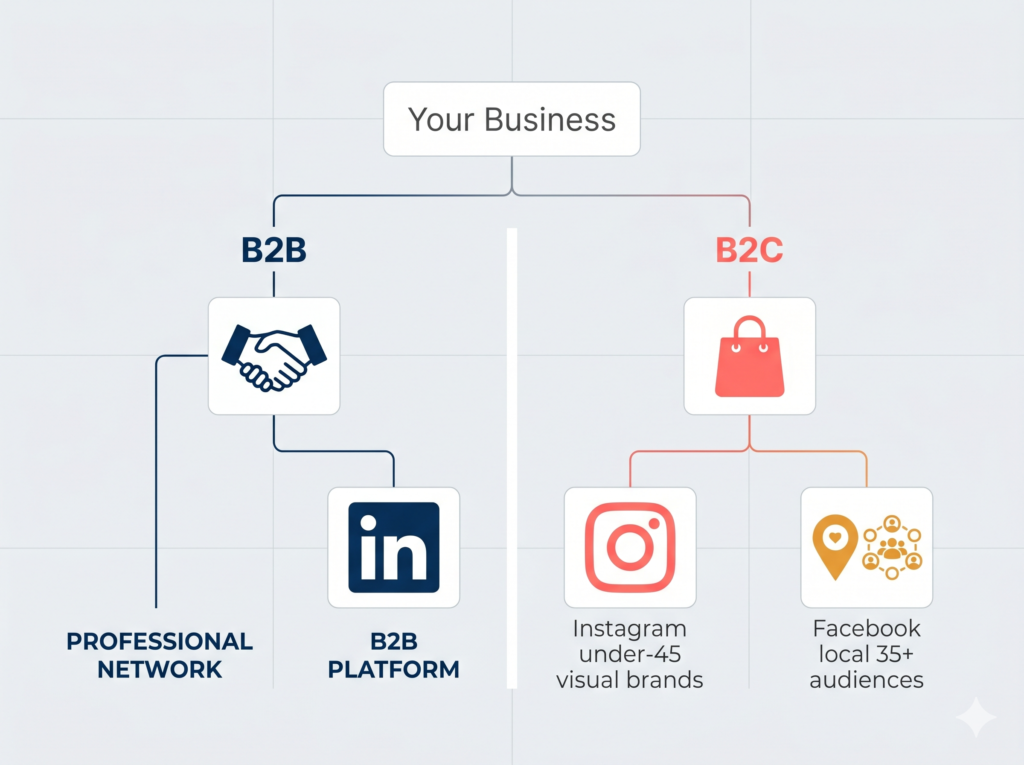
Question 1: Are you selling to businesses or consumers? If your buyer is another business — a company, a professional, a decision-maker acting in a professional capacity — LinkedIn is your primary platform. The concentration of purchase-intent B2B audience on LinkedIn has no equivalent on Instagram or Facebook. If you are selling to individual consumers, Instagram or Facebook is the more relevant surface depending on your audience’s age profile and your content capability.
Question 2: What can you actually produce consistently? Platform selection is only half the decision. The other half is content format. If your strength is writing and professional insight, LinkedIn text posts and carousels are your lane. If you can produce short-form video consistently, Instagram Reels give you the best organic discovery potential available on any major platform in 2026. If you hate being on camera and struggle to write in a personal voice, Facebook Groups participation — which requires neither — may be your most sustainable option. The best platform for your business is the one where your content capability matches the format that the algorithm rewards.
Question 3: What does success look like — reach, leads, or community? Brand awareness and discovery favour Instagram. Direct lead generation and professional pipeline favour LinkedIn. Community-building and local word-of-mouth favour Facebook Groups. Aligning the platform’s strength with your actual goal prevents the most common small business mistake: using Instagram to try to generate B2B leads, or using LinkedIn to reach a consumer audience that is not there.
For most small businesses, the right answer is one primary platform and one secondary platform — not five. Spreading thin across every channel produces content that is too generic to perform on any of them.
What the Data Says: A Platform Comparison for 2026
The table below consolidates the key metrics that matter for small business platform decisions in 2026.
| LinkedIn (Personal) | LinkedIn (Company Page) | Facebook (Business Page) | ||
| Organic reach rate | 3–4% of followers | Significantly higher; not publicly benchmarked | 2–5% of followers | 1–3% of followers |
| Best content format | Reels (15–60s), carousels | Document carousels (6.6% engagement), video | Same, but lower distribution | Facebook Groups, boosted posts |
| Primary audience | 18–44, consumer-facing | B2B decision-makers, professionals | Same | 35–65+, local/community focus |
| Lead generation potential | Low–medium (link friction) | High (for B2B) | Medium (lower reach) | Low organically; high via ads |
| Content investment required | High (video production) | Medium (writing + design) | Medium | Low (Groups participation) |
| 2026 algorithm direction | Rewards Reels consistency | Rewards knowledge-sharing, penalises link posts | Deprioritised vs personal | Deprioritised for organic content |
Sources: Ordinal (January 2026), Sales So (2026), Socialinsider (2025 benchmarks), Gray Reserve (July 2025), Wordstream (February 2026).
The Organic Social Media Trap — and the Strategic Alternative
There is a pattern worth naming directly, because it affects the majority of small businesses currently investing time in social media.
The trap is this: organic social media feels like a free channel, so it attracts time investment without the same scrutiny applied to paid spend. But time is not free. When a small business owner spends four hours per week creating and posting content that reaches 40 people on Facebook, the cost per impression — when calculated against hourly rate — is often higher than a modest paid campaign that guarantees reach to a specific audience.
The strategic alternative is the content-to-paid flywheel described by Gray Reserve’s 2025 analysis: publish organically to identify what resonates, then amplify the winners with paid distribution to the audience organic posts cannot reach. This approach uses organic content as a testing mechanism rather than a distribution strategy — a meaningful distinction for any business with limited marketing bandwidth.
For businesses that want organic social to drive genuine business outcomes without paid amplification, the realistic expectation is this: it takes six to twelve months of consistent, high-quality output on the right platform before compounding returns begin. LinkedIn thought leadership from a founder or key team member is the strongest organic social investment available to B2B small businesses in that timeframe. Instagram Reels, with consistent production over the same period, is the equivalent for B2C visual businesses.
Neither is fast. Both require choosing the right platform first — which is the decision this post exists to help you make.
Which Platform Should Your Small Business Be On in 2026?
The answer is not Instagram, LinkedIn, or Facebook. The answer depends on who you are selling to, what you can produce, and what you are trying to achieve.
B2B service businesses — consultants, agencies, accountants, solicitors, SaaS, recruiters: LinkedIn personal profile, posting thought leadership content three to four times per week. Company page as secondary infrastructure. Budget permitting, LinkedIn outbound as a systematic lead generation layer alongside content.
B2C product or visual service businesses — retail, food, interiors, fitness, beauty, creative services: Instagram, primarily through Reels. Consistent video production three to five times per week. Instagram Stories for community connection. Facebook as a secondary channel only if the audience is 35+ and local.
Local service businesses — trades, healthcare, hospitality, childcare, home services: Facebook — not the business page for organic reach, but Facebook Groups for community participation and paid local advertising on the Meta platform. Google Business Profile as a priority above all social platforms for local search visibility.
Mixed B2B and B2C businesses or early-stage brands still finding their audience: Start with the channel that matches your content capability, not the one with the largest user base. Commit to one platform for six months before expanding. Measure leads and enquiries generated, not likes.
Tabula works with small businesses to build social media strategies that match their actual goals and bandwidth — not generic content calendars that consume time without generating pipeline. If you are also thinking about how your brand gets discovered beyond social — including in AI search results — generative engine optimisation is the next strategic layer worth understanding. If you’re not sure which platform is right for your business, or you’ve been posting consistently without seeing results, a strategy conversation will identify the gap.