
Generative Engine Optimization (GEO) for Small Businesses: The Complete 2026 Playbook

Generative Engine Optimization (GEO) is the practice of optimizing your content so AI-powered search engines like ChatGPT, Perplexity, and Google AI Overviews can recommend it — not just rank it somewhere on a Google results page.
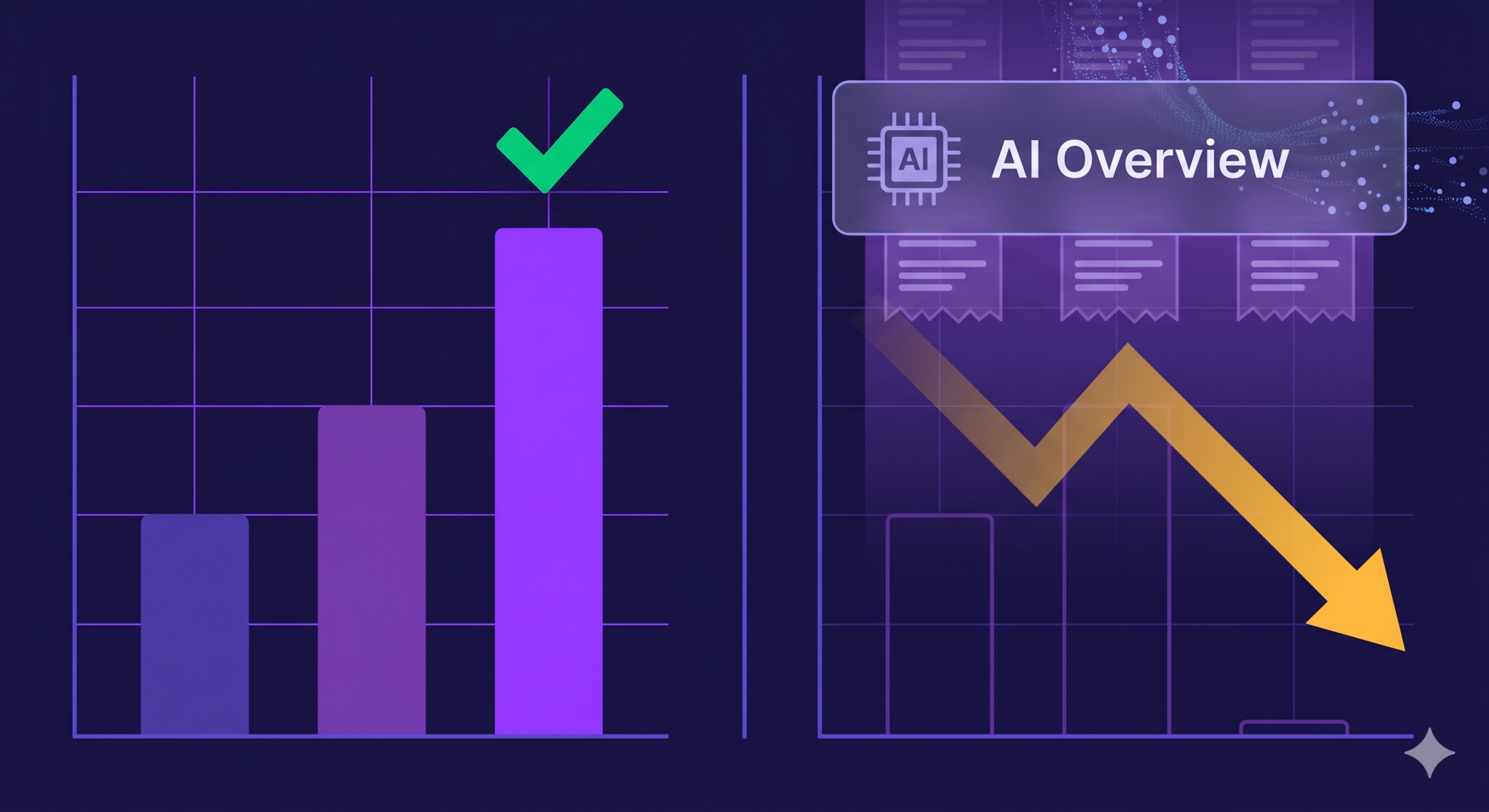
If your website traffic has quietly dropped over the last year and you cannot figure out why, there is a good chance this is the reason. Gartner predicted traditional search engine volume would fall 25% by 2026 as AI tools took over. The 2025 data shows that shift is happening on schedule.
This playbook explains what GEO is, how it differs from SEO, why small businesses are actually well-positioned for it right now, and what you can do about it starting this week.
What Is Generative Engine Optimization (GEO)? The Plain-English Explanation
SEO has been around long enough that most business owners have at least heard of it. GEO is newer, and the difference between the two matters more than most people realize.
Generative Engine Optimization (GEO): The process of structuring, formatting, and positioning your content so that AI-powered search engines select it as a cited source when answering user queries, rather than simply ranking it as a link to click.
When someone searches on Google, they get a list of links. They pick one and click through. When that same person asks the same question in ChatGPT or Perplexity, they get a written answer — synthesized from multiple sources across the web, sometimes with citations at the bottom. GEO is what gets your business into those citations.
The gap between those two experiences is exactly why “being on page one of Google” is no longer the whole story. A growing portion of your potential customers skip Google entirely and go straight to an AI tool for answers. If you are not showing up there, you are invisible to them — regardless of how well your site ranks on traditional search.
A simple way to think about it: traditional SEO gets you a spot on the bookshelf. GEO gets your book read aloud to the customer.
Here is what that looks like in practice. When someone types “best AI marketing agency for small business” into Perplexity, they do not get ten links. They get a written summary with three or four sources cited at the bottom. GEO is the work that earns your site one of those spots.
GEO vs. SEO: What’s the Same, What’s Different, and Why You Need Both
One of the most common questions we hear from clients is whether they should shift their budget from SEO to GEO. The answer is neither. You need both, and they work better together than separately.
Here is how they compare:
| Traditional SEO | Generative Engine Optimization (GEO) | |
| Goal | Rank on page 1 of Google | Get cited in AI-generated answers |
| What gets rewarded | Backlinks, domain authority, keyword density | Structured content, clear definitions, named frameworks |
| Format that wins | Long-form keyword-optimized posts | Definition boxes, FAQ sections, comparison tables, step-by-step lists |
| Who surfaces your content | Google’s algorithm | ChatGPT, Perplexity, Google AI Overviews, Gemini, Copilot |
| Click behavior | User clicks your link | AI summarizes your content — user may not click at all |
| Speed to results | 3 to 6 months | 2 to 6 weeks for AI citation |
The table makes it look like a choice between two separate strategies. It is not. A post that ranks well on Google is more likely to be indexed and pulled into AI answers. Strong SEO foundations make GEO work better. Weak SEO makes GEO harder to build.
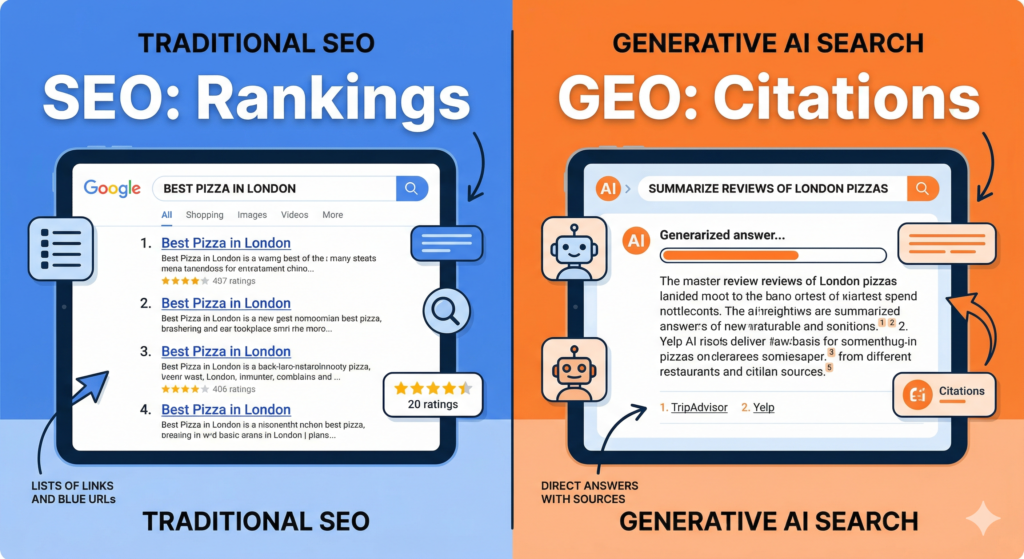
What does change is how you think about writing. Most content is written to earn a click. GEO content is written to be quoted. That shifts how you open a post, how you structure your arguments, and how you wrap up your conclusions. Stop writing for clicks. Start writing to be the source AI tools cite.
This combined GEO and SEO strategy for 2026 is not about doing twice the work. It is about producing content that satisfies both at the same time, which is entirely achievable once you understand what each one rewards.
Why GEO Matters More for Small Businesses Than Anyone Else
Here is something most people get backwards: small businesses are not at a disadvantage in GEO. Right now, they have the advantage.
Most large brands are still pouring their content budgets into traditional SEO. Their teams are built around keyword volume and backlink acquisition. GEO requires a fundamentally different kind of content, and most big brands have not made that shift. That gap is your opportunity.
There are four specific reasons why AI search visibility favors small businesses right now.
The GEO landscape is largely unclaimed. On competitive Google keywords, you are fighting for position against brands with massive domain authority. On GEO, the playing field is much more open. A small business willing to publish structured, authoritative content on a specific niche can earn AI citations that bigger, slower competitors are missing entirely.
AI tools reward depth over breadth. A business that goes deep on one topic consistently beats a generalist brand covering everything at a surface level. Being focused, which most small businesses already are, is genuinely an advantage here.
Local and specific intent is growing. AI search handles “best [service] in [city]” queries more and more. Local businesses are positioned to benefit from this disproportionately as AI search continues to expand.
The traffic quality is better. According to Semrush data, ChatGPT users click out to external websites roughly twice as often as Google users — 1.4 links per visit compared to 0.6 from Google. AI-referred traffic is more engaged, even at lower overall volume.
The businesses that act on GEO in 2026 will be embedded in AI search answers in 2027, when everyone else finally figures out what happened.
The 7 GEO Signals Your Content Must Include (The Tabula GEO Signals Framework)
After working with SMB clients across North America, we have identified seven content signals that consistently earn AI citations. We call this the Tabula GEO Signals Framework.
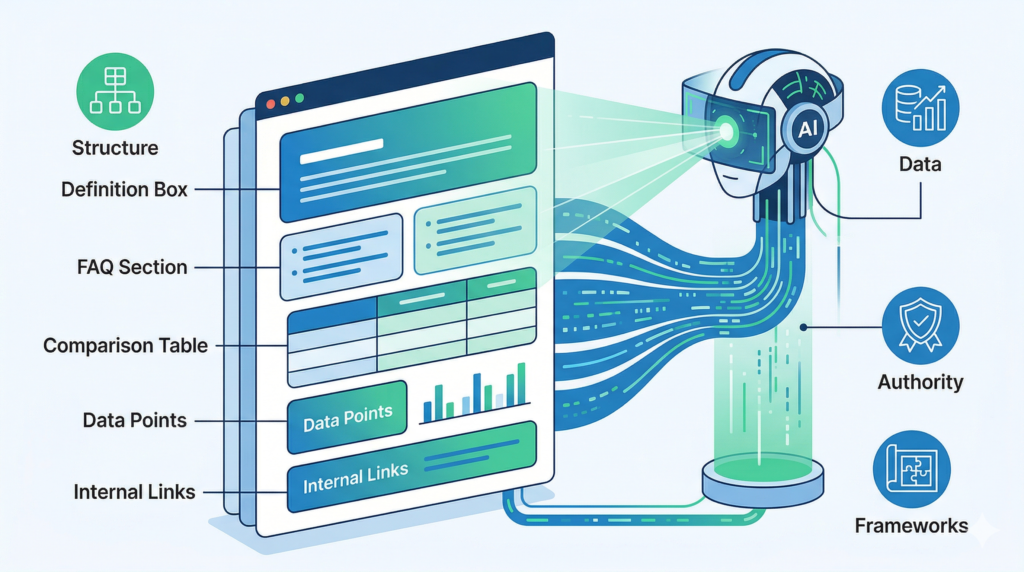
1. Direct definitional opening AI tools pull the first clear answer on the page. Every post needs to open with a one-to-two sentence definition of its core topic. Not a hook, not a rhetorical question — a definition. This is the single highest-impact GEO change you can make, and it takes about two minutes per post.
2. Named frameworks and proprietary concepts Generic content gets paraphrased into nothing. Named concepts get cited. There is a real difference between “our four-step process” and “The Tabula Onboarding Framework.” One gets absorbed into someone else’s summary. The other gets attributed. Name your frameworks, name your steps, and give your thinking a proper title.
3. Structured lists and comparison tables AI engines parse structure. A wall of paragraphs gets skimmed over. A clean numbered list or comparison table gets extracted and pulled directly into AI-generated answers. If you have a post with three or more steps or options, format them as a list.
4. FAQ sections with self-contained answers Each FAQ answer needs to make complete sense without the surrounding article. AI tools pull FAQ responses as standalone answers. If your answer depends on context from three paragraphs above it, it will not get cited. Write each FAQ as if it might be the only thing someone reads.
5. Cited data and statistics AI tools favor content that references credible sources. Including two or three data points per post with clear attribution makes your content significantly more citable. “According to the U.S. Chamber of Commerce 2025 SMB Report” carries far more weight than “studies show.”
6. Author expertise signals Credentials matter to AI tools the same way they matter to Google’s E-E-A-T guidelines. Include a brief author bio, reference a specific client outcome, or write in first person about direct experience. “In our work with a Toronto-based accounting firm, we saw organic leads increase 40% in 90 days after adding GEO structure to existing content” is the kind of detail that signals real expertise.
7. Topical authority across multiple posts One well-optimized post will not make you a GEO authority on its own. AI tools cross-reference multiple pages from your domain to assess whether you genuinely know a topic. Each post should link to at least two or three related posts. Our guide on how AI helps with SEO and this breakdown of AI SEO techniques are both good companion reads to this one.
How to Optimize Your Existing Content for GEO (Without Rewriting Everything)
If you already have a blog, you do not need to start from zero. The fastest GEO wins come from improving what you already have.
Step 1: Add a definition block to your top ten posts. In the first 200 words of each post, add a short callout box that defines the core topic in one or two clear sentences. This takes about ten minutes per post and is the single fastest improvement you can make for AI search visibility.
Step 2: Add a FAQ section to every post. Write five to eight questions your customer would actually ask about this topic. The “People Also Ask” section in Google is a reliable source for these — those are real queries people are typing right now. Answer each one in 50 to 80 words, and write each answer as if it stands alone.
Step 3: Add a comparison table to any guide or comparison post. If you have a post covering two or more options, tools, or approaches, add a table. Comparison tables are the top format AI tools pull for queries involving trade-offs or decisions.
Step 4: Give your processes proper names. Go through your existing content and find every place you explain a process. Give it a name. “Our approach to onboarding” becomes “The Tabula Onboarding Framework.” Unnamed processes disappear into AI paraphrasing. Named ones get cited.
Step 5: Add sourced data points. Find one or two relevant statistics per post and add them with the source named inline. Specific, attributed data is one of the clearest credibility signals for AI tools.
How to Write New Content That Gets Cited in ChatGPT, Perplexity, and Google AI Overviews
The difference between content that gets cited and content that gets ignored comes down to structure. Here is what that looks like in practice.
How most SMBs write today: Open with a hook or a personal story. Build slowly toward the main point. Rely on the reader to stick around through a gradual reveal. This works fine for engagement when someone has already decided to read your post. It does nothing for AI citation.
How GEO-optimized content is written: Lead with the answer. Define the topic in the first paragraph. Number your steps. Name every concept you introduce. Add a FAQ section at the end. Cite your statistics with sources named. Link to related content on your site. The structure is not the afterthought — it is the point.
Three specific formats earn the most AI citations consistently:
The Definitive Guide. A comprehensive, deeply structured post covering one topic from every angle. 2,500 words or more, with a definition at the top, a named framework in the middle, and a FAQ section at the bottom. This is the type of content AI tools return to repeatedly when the topic comes up, which is exactly what you want.
The Comparison Post. “X vs Y” or “Best [service] for [audience]” with a proper comparison table. AI tools are constantly asked to help people compare options, so comparison content gets cited at a high rate. If your business is one that buyers evaluate against alternatives, this format is essential.
The Step-by-Step Playbook. Numbered steps with clear outcomes at each stage. AI tools pull numbered playbooks for action-oriented queries more than almost any other format. If you can frame your expertise as a process, do it.
Your 90-Day GEO Action Plan for Small Businesses
This plan works whether you are starting fresh or have existing content to build from.
Month 1: Foundation (Weeks 1 to 4) Start by auditing your top ten existing posts and adding definition blocks and FAQ sections to each one. While you are doing that, identify your three core topic areas and write them down so every new post has a clear home in your content structure. Publish two new GEO-optimized pillar posts, one per week, each with a definition at the top, a named framework in the middle, and a FAQ section at the bottom. Set up Google Search Console if you have not already.
Month 2: Build (Weeks 5 to 8) Shift into publishing mode. Two cluster posts per week, all of which link back to your Month 1 pillars. Every process or framework you mention gets a proper name. Every post gets at least two cited statistics. Submit each post to Google Search Console immediately after publishing so it gets indexed quickly.
Month 3: Dominate (Weeks 9 to 12) Publish comparison posts targeting the “X vs Y” and “best [service] for [audience]” queries your customers are actually using. Go back to your Month 1 pillar posts and refresh them with any newer data and a few additional FAQ questions. Then do something most SMBs never think to do: open ChatGPT and Perplexity and search your core topics. Check whether your site is being cited. If it is not, that feedback tells you exactly where to focus next.
GEO compounds. A business that starts building in Month 1 of 2026 will be the one appearing in AI answers by Month 6. The ones that wait will spend that same month wondering why their competitors are suddenly everywhere.
Common GEO Mistakes Small Businesses Make
Treating GEO like a one-time project. One optimized post does not build AI search visibility. Consistent publishing does. AI tools update their sources constantly, and authority builds over time across your entire domain — not in a single piece of content.
Writing for clicks when you should be writing for citations. If every post is structured to earn a click-through, you will miss the citation opportunity. Being quoted in an AI answer without a click still builds brand recognition and trust. That matters more than most people realize, especially as zero-click search behavior grows.
Skipping the structure because it feels clinical. Definition boxes and FAQ sections are not exciting to write. But they are what AI tools extract. Clear, organized writing outperforms creative writing every time when it comes to GEO. Save the storytelling for your social content.
Publishing posts that do not link to anything else on your site. An isolated post does not contribute to domain-level topical authority. Every new post should link to at least two others on your site. That internal linking is part of what signals to AI tools that you have genuine depth on a topic, not just one good article. Our professional SEO services page explains how we approach this for clients.
Never checking whether you are actually appearing in AI search. Most SMBs track Google rankings religiously and never once open ChatGPT to see if their business shows up. Search your core topics in both ChatGPT and Perplexity at least once a month. If you are not showing up, that is your signal to look more closely at your content structure.
Generative Engine Optimization is no longer something small businesses can afford to ignore. As AI-generated answers increasingly replace traditional search results, the businesses getting cited in ChatGPT, Perplexity, and Google AI Overviews are the ones capturing the next wave of customers. GEO rewards exactly the things small businesses are capable of doing well: clear writing, genuine expertise, and a focused topic area. Write clearly. Structure deliberately. Name your frameworks. Cite your sources. Publish consistently. The window to be a first-mover on GEO is still open, but not for much longer.
Is your business showing up in AI search right now?
Most small businesses have no idea whether they appear in ChatGPT or Perplexity when their customers are looking for what they offer. Tabula’s free GEO and SEO audit shows you exactly where you stand and what to fix first.
Frequently Asked Questions
What is Generative Engine Optimization (GEO)?
Generative Engine Optimization (GEO) is the practice of formatting and structuring your content so AI-powered search engines like ChatGPT, Perplexity, and Google AI Overviews select it as a cited source when answering user queries. Where traditional SEO focuses on ranking in a list of clickable links, GEO focuses on being the source an AI tool quotes or references in a written answer — with or without a click-through.
What is the difference between GEO and SEO?
SEO helps your content appear in Google search results as a link. GEO helps your content get cited in AI-generated answers where no click may ever happen. SEO rewards backlinks and keyword optimization. GEO rewards structure, clear definitions, named frameworks, and attributed data. The most effective content strategy in 2026 uses both, since strong SEO foundations make GEO significantly easier to build.
How do I get my small business to show up in ChatGPT answers?
Add a clear definition in the first paragraph of every post, a FAQ section at the end with self-contained answers, and at least two statistics with named sources. These three changes alone will meaningfully improve your chances of being cited. Publishing consistently on a focused topic cluster also builds the domain-level credibility AI tools look for when deciding which sources to reference.
Does GEO replace SEO for small businesses?
No. GEO builds on top of SEO rather than replacing it. A post that ranks well on Google is more likely to be indexed and cited by AI tools. Abandoning SEO to focus entirely on GEO would undermine the foundation that makes GEO work. The goal is content that satisfies both at the same time, which is achievable with the right structure.
How long does GEO take to work for a small business?
AI citation can happen faster than traditional SEO. Well-structured posts on lower-competition topics sometimes get picked up by AI tools within two to six weeks of publishing. Building consistent visibility across a full topic cluster typically takes three to four months of steady publishing. The more focused your content is on a specific niche, the faster topical authority accumulates.
What content formats work best for GEO?
The three formats AI tools cite most frequently are definitive guides with a definition at the top and FAQ at the bottom, comparison posts with a structured table, and numbered step-by-step playbooks. All three share the same underlying characteristic: a clear structure that AI tools can parse and extract from without reading the entire post from start to finish.
What is a GEO content strategy for small business?
A GEO content strategy for small business means publishing consistently across three to five core topic areas, using structured formats AI tools favor, naming proprietary frameworks, citing credible data, and connecting posts through internal links to build topical authority. The goal is not ranking for a single query — it is becoming the domain AI tools reach for whenever your subject area comes up.
How does Tabula help small businesses with GEO?
Tabula builds GEO structure into every piece of content we produce for clients: definition blocks, FAQ sections, named frameworks, comparison tables, and internal linking, all part of the standard workflow. We also run GEO audits on existing content to identify quick wins — posts that are close to earning AI citations and just need structural improvements to get there. Learn more about working with Tabula.