

SEO vs GEO: The Evolution of Search and What It Means for Your Business

You type a question into Google and an AI-generated answer fills the top of the page before you see a single blue link. You ask ChatGPT which agency to call and it names three businesses without showing you a ranked list. Your potential customers are finding answers, and sometimes finding your competitors, without ever visiting a search results page at all.
The way people discover businesses online changed in 2025, and most marketing strategies did not change with it.
Traditional SEO is not dead, but it is no longer enough on its own. A new discipline called Generative Engine Optimization has emerged alongside it, and understanding how the two differ is now one of the most important things you can do for your visibility.
This post breaks down exactly what SEO and GEO each do, how they differ, and what you need to build so your business shows up in both places. No jargon. Just a clear picture of where search is heading and what to do about it.
SEO (Search Engine Optimization) and GEO (Generative Engine Optimization) are two distinct but complementary strategies for getting your business found online: SEO targets traditional search engines like Google to earn ranked positions and clicks, while GEO targets AI platforms like ChatGPT, Perplexity, and Google AI Overviews to earn citations inside AI-generated answers.
The key differences between SEO and GEO:
- Goal: SEO earns ranked positions in search results. GEO earns citations and mentions inside AI-generated answers.
- Platform: SEO targets Google, Bing, and traditional search engines. GEO targets ChatGPT, Perplexity, Gemini, and AI Overviews.
- Success metric: SEO measures rankings, organic traffic, and click-through rates. GEO measures brand mentions, citation frequency, and share of voice in AI responses.
- Content format: SEO rewards keyword-optimized, long-form pages. GEO rewards structured, self-contained, fact-rich paragraphs that AI can extract and cite.
- The shift: Gartner predicts a 25% drop in traditional search volume by end of 2026 as AI platforms absorb informational queries.
- The right approach: Running both in parallel is not optional in 2026. SEO without GEO leaves you invisible in AI answers. GEO without SEO leaves you without the authority signals AI engines use to decide who to cite.
How Traditional SEO Works (And Why It Still Matters)
What it means: Search Engine Optimization is the practice of optimizing your website, content, and authority signals so that Google and other traditional search engines rank your pages as high as possible for relevant queries.
Why it still drives real results: Google processes an estimated 16.4 billion searches per day and still holds roughly 80% of global query volume according to Similarweb 2026 data. For navigational and transactional searches like “accountant in Toronto” or “best CRM for small business,” Google remains the dominant discovery channel by a wide margin. A service business owner whose website ranks on page one for her primary service keyword can realistically attribute 30 to 40 percent of her new client inquiries to that single ranking. Lose it and the pipeline dries up.
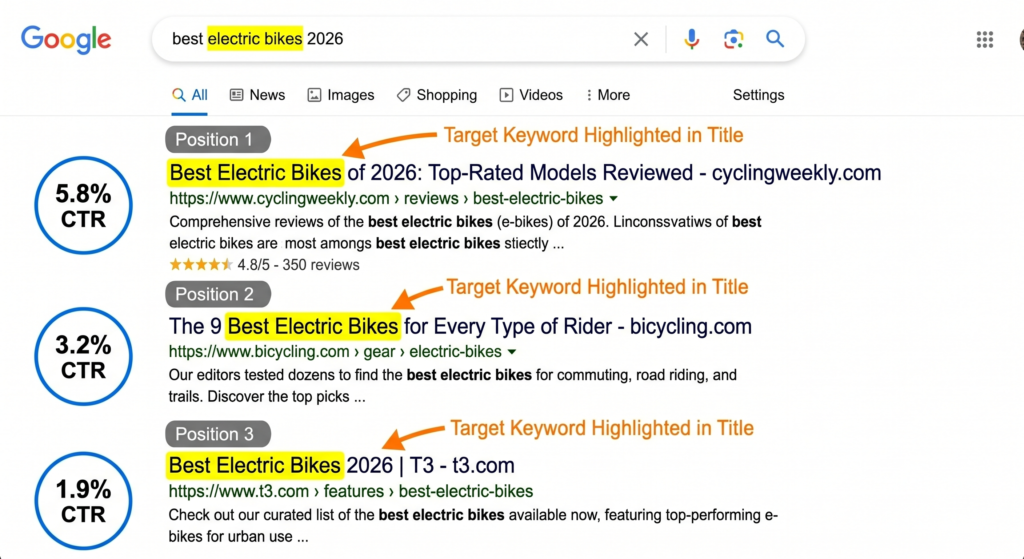
How to check right now: Open Google Search Console (free at search.google.com/search-console) and look at your top five performing queries from the last 90 days. Check whether you are in positions 1 through 10. If your best keyword is sitting at position 11 or below, you are capturing a fraction of the available clicks. That gap is where SEO investment pays off most directly.
The Tabula fix: Tabula’s professional SEO services are built around technical site health, content architecture, and sustained authority building. We do not chase algorithm shortcuts. We build the structural foundation that earns rankings and holds them. Every client engagement starts with a full site audit that maps where rankings are leaking and exactly why.
How GEO Works (And Why It Is Now Essential)
What it means: Generative Engine Optimization is the practice of structuring your content so that AI platforms like ChatGPT, Perplexity, Google AI Overviews, and Gemini cite your brand as a source when generating answers to user queries.
Why ignoring it costs you visibility: AI referral traffic grew 527% year-over-year in the first half of 2025, and Gartner predicts traditional search volume will drop 25% by the end of 2026 as users shift toward AI-mediated discovery. The critical insight most businesses miss: 80% of LLM citations do not rank in Google’s top 100 results for the original query. Ranking well on Google does not automatically get you cited by AI tools. A consultant who has spent three years building strong Google rankings might generate zero mentions in ChatGPT or Perplexity simply because his content is not structured for AI extraction. Meanwhile, a competitor with weaker traditional rankings but well-structured, fact-rich content earns citations every time a relevant question gets asked.
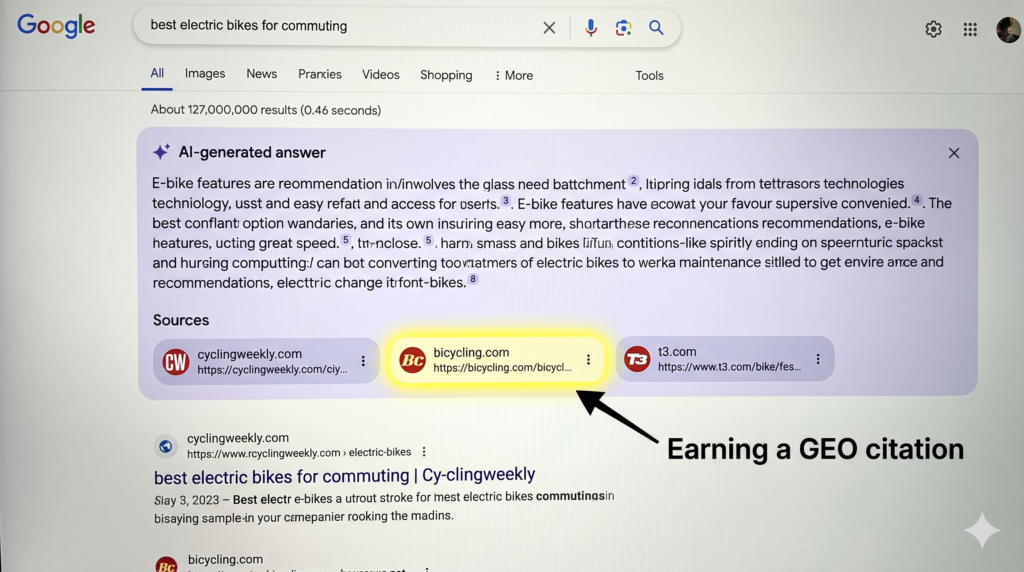
How to check right now: Open ChatGPT or Perplexity and type the most common question your customers ask about your service. Read the answer carefully. Note how many times your brand is mentioned versus your competitors. If the answer is zero, that is your GEO gap in plain view. Run the same query in Google and check whether an AI Overview appears above the organic results.
The Tabula fix: In almost every content audit we run, we find clients with strong page content that AI systems simply cannot extract because the answer is buried in paragraph three, there are no supporting statistics, and the structure gives AI nothing clean to attribute. Tabula’s GEO framework restructures existing content for citation readiness without destroying existing rankings. Our guide on what generative engine optimization actually means for small businesses explains the full process from audit to optimization.
The Five Core Differences Between SEO and GEO
What it means: SEO and GEO reward different content behaviors, use different success metrics, and operate on different timelines. Treating them as the same discipline causes you to optimize for the wrong signals on each platform.
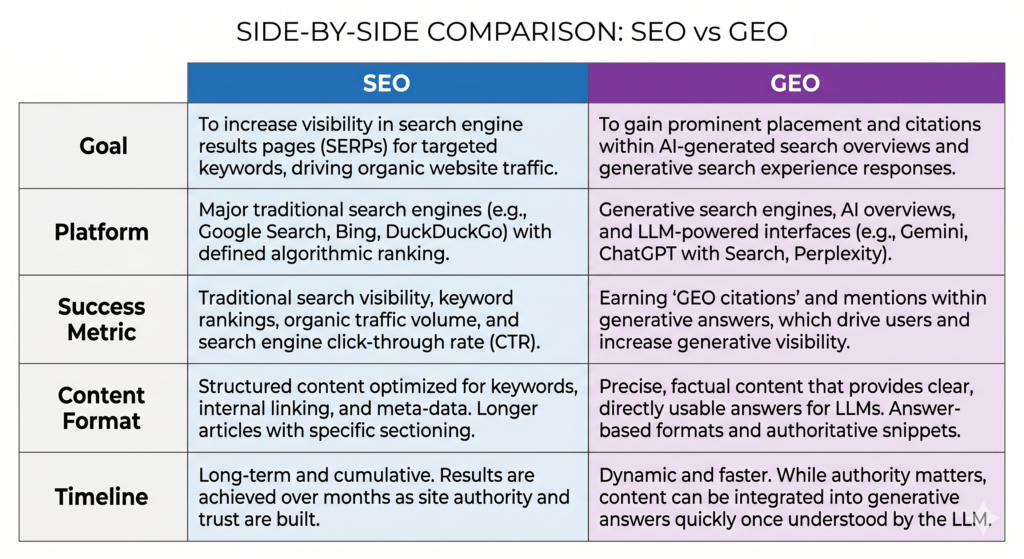
Why the distinction matters for your content: Content with statistics, citations, and structured headings achieves 30 to 40% higher visibility in AI responses than unstructured prose, according to Superlines 2026 research. Yet most businesses are still writing for Google and assuming AI tools will pick it up automatically. A local marketing agency might publish a well-researched 2,000-word SEO blog post that ranks on page one. That same post could still fail to appear in a single AI-generated answer because it never opens with a direct answer sentence, uses no linked data points, and has no subheading structure that AI can isolate and cite. The writing decisions that earn a Google ranking and the writing decisions that earn an AI citation are related but genuinely different.
How to check right now: Open one of your top-performing blog posts and ask these three questions. Does the first paragraph answer the core topic question in two sentences or fewer? Does the post include at least one named statistic linked to a published source? Are the subheadings phrased as questions or direct insight statements rather than vague labels? If the answer to any of these is no, that post is likely earning Google traffic but missing AI citations.
The Tabula fix: Understanding how AI is changing SEO requires seeing both disciplines clearly. Tabula’s content scoring system evaluates every piece of content against SEO signals and GEO citation readiness at the same time. When we identify gaps, we use targeted section rewrites rather than full replacements, which preserves existing rankings while improving citation potential.
Why You Cannot Choose One Over the Other
What it means: SEO and GEO are not competing strategies. They are complementary layers of a complete search visibility system, and removing either one creates a gap the other cannot fill.
Why running both is the only viable approach: Research from Ahrefs shows that 43.2% of pages ranking number one on Google are cited by ChatGPT, which means strong SEO authority still feeds GEO citation potential. At the same time, the same research confirms that 80% of LLM citations come from pages that do not rank in the top 100 on Google, which means GEO requires its own deliberate optimization on top of SEO. We have seen clients who cut SEO investment to focus entirely on GEO lose the domain authority that AI tools were relying on as a trust signal. The businesses gaining ground in 2026 run integrated strategies where SEO builds the authority foundation and GEO structures the content for AI extraction.
How to check right now: Ask yourself two questions without opening any tools. Do you know your current ranking positions for your five most important keywords? And do you know whether your brand is being cited in AI answers for those same topics? If you cannot answer both questions, you have incomplete visibility into your own search presence.
The Tabula fix: Rather than treating SEO and GEO as separate service lines, Tabula builds them as a single system from the first brief. If you are seeing traffic decline without an obvious reason, the guide on why your website traffic is dropping in 2026 covers this exact pattern. And for the practical steps on AI platform visibility specifically, our guide on how to get found in ChatGPT and Perplexity walks through every optimization decision in sequence.
The evolution from SEO to an integrated SEO and GEO strategy is not a future trend worth bookmarking for later. It is happening in every industry right now, and the gap between businesses that understand it and businesses that do not is widening every month.
The good news is that the fundamentals overlap: quality content, genuine expertise, and clear structure serve both traditional search and AI-driven discovery at the same time. The businesses that build for both from the start will not have to retrofit their strategy in two years. If you are unsure where your current visibility stands on either front, Tabula’s professional SEO services include a full SEO and GEO gap assessment as the starting point for every new engagement.
FREE SEO + GEO VISIBILITY AUDIT
You just learned what the gap looks like. Now find out exactly where your business stands.
The Tabula team has audited the search visibility of hundreds of small businesses across North America, identifying the exact SEO and GEO gaps costing each one traffic, citations, and leads.
Book a free 30-minute SEO and GEO Visibility Audit with Tabula. You will walk away with:
- A clear picture of your current Google ranking positions for your five most important keywords
- An assessment of whether your brand is being cited in AI-generated answers on ChatGPT and Perplexity
- The top two or three content changes that would immediately improve your GEO citation readiness
- Zero obligation — this is a diagnostic session, not a sales call
Not ready to book? Explore Tabula’s professional SEO services to see how we build search visibility across both traditional and AI-powered platforms.
Frequently Asked Questions
The clearest way to diagnose a GEO problem is to type the questions your customers ask most often into ChatGPT, Perplexity, and Google with AI Overviews enabled, then check whether your brand appears in any of the generated answers. If your competitors are cited and you are not, you have a GEO gap. A secondary signal is declining organic click-through rates despite stable Google rankings, which typically indicates that AI Overviews are resolving queries before users reach your listing. Businesses in informational categories such as professional services, marketing, and finance are most affected by this pattern.
A business with effective SEO and GEO running in parallel ranks in the top positions on Google for its primary keywords and appears as a cited source in AI-generated answers for those same topics. Its content opens with direct answers, uses named statistics linked to authoritative sources, and is structured so AI systems can extract and attribute specific claims. It measures success through both traditional analytics such as organic traffic and conversions, and through AI visibility metrics such as brand citation frequency across ChatGPT, Perplexity, and Google AI Overviews.
Content should be reviewed and updated at minimum every three months for GEO, because pages updated within the past two months earn 28% more citations in AI responses than older content, according to Superlines 2026 research. For high-value service pages and pillar content, a quarterly review that refreshes statistics, updates examples, and checks whether the opening paragraph still provides a direct answer is the minimum standard. AI systems prioritize both freshness and accuracy, so outdated statistics are one of the most common reasons previously cited content loses its citation position over time.
GEO optimization does not require a separate content budget in most cases. The primary investment is time: auditing existing content for citation readiness, restructuring posts that are not AI-extractable, and building a publishing rhythm that consistently includes the structural elements AI platforms reward. For businesses starting from scratch, the content investment to build GEO citation authority is similar in scale to a foundational SEO strategy, typically three to six months of consistent, structured publishing before citation frequency begins to climb measurably.
GEO is primarily a content optimization discipline, but it has technical prerequisites. On the content side, it requires structured writing with direct answers in the first paragraph, named statistics, and question-formatted subheadings. On the technical side, your site must be crawlable by AI bots including GPTBot and CCBot, and schema markup such as Article, FAQ, and HowTo schemas improves the probability that AI systems interpret your content correctly. For most small businesses, the content side is the higher-leverage starting point because structural content gaps are far more common than technical crawl issues.
SEO success is measured through rankings, organic traffic volume, click-through rates, and conversions attributed to search. GEO success is measured through brand citation frequency in AI responses, share of voice across AI platforms, and the quality of how AI tools describe and position your brand when answering relevant queries. Traditional analytics tools like Google Analytics do not capture most GEO value because AI-influenced discovery often results in zero-click brand recognition rather than a direct referral visit. Businesses optimizing for GEO need to supplement standard analytics with regular manual testing across ChatGPT, Perplexity, and Google AI Overviews to understand their actual citation position.