
Is Google’s AI Overview Eating Your Traffic? How to Know for Sure

Your rankings haven’t moved. Your content is solid. But your organic traffic is quietly falling — and Google Search Console isn’t giving you a straight answer.
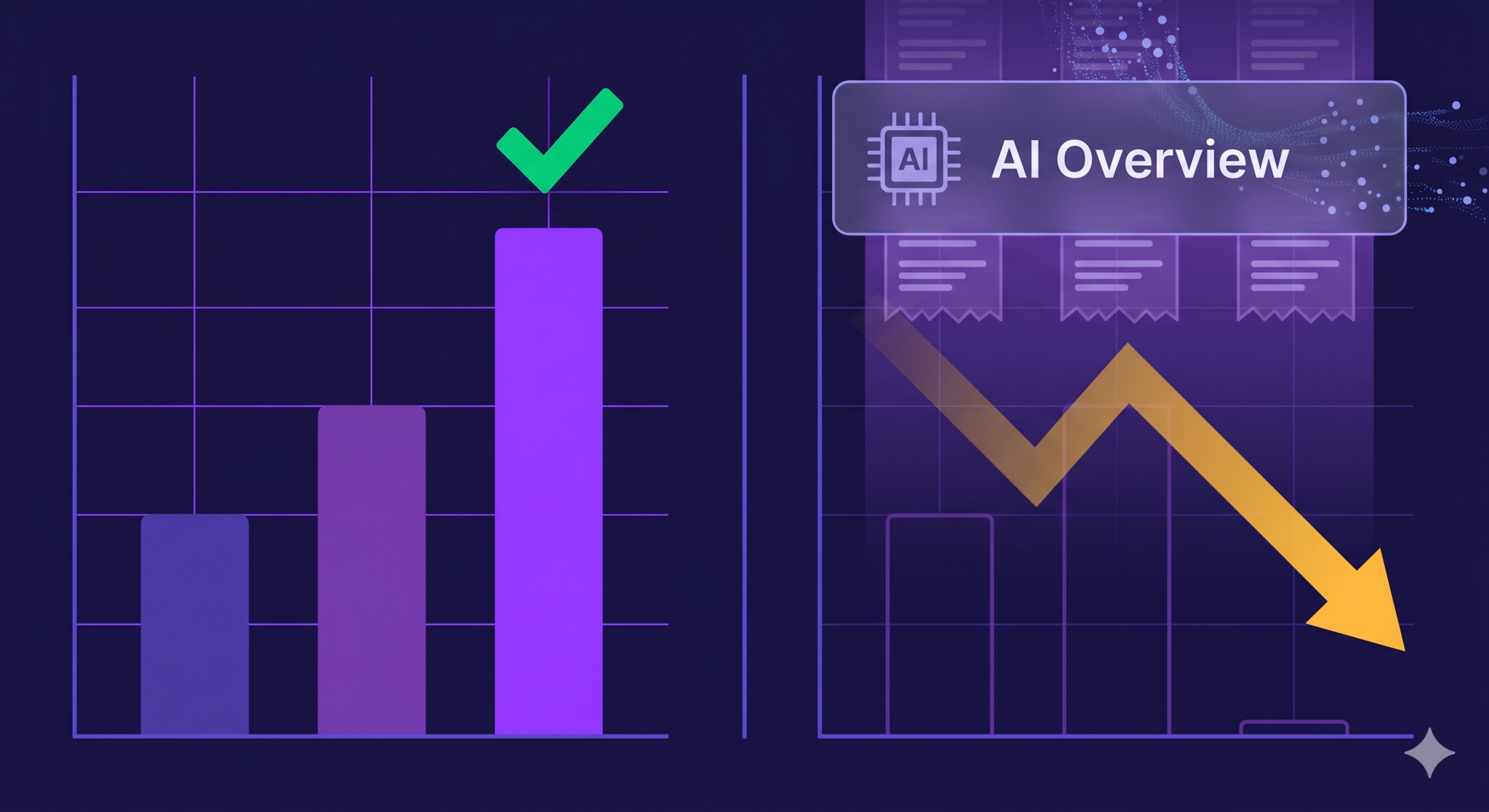
The page is ranking. Nobody is clicking. Google’s AI Overview is answering the question before anyone reaches the result.
This post gives you the exact four-step diagnostic process to confirm whether AI Overviews are cannibalising your traffic, which signals to look for in GSC, and what to do once you know the answer.
If your rankings are stable but traffic is falling, AI Overview cannibalisation is the most likely cause. To confirm it: pull your GSC queries for the last 90 days, filter for high-impression / zero-click patterns, cross-reference with position data, and check whether those queries now trigger AI Overviews in Google. Once confirmed, the fix isn’t to rank higher — it’s to restructure your content so Google’s AI system cites you inside the Overview rather than answering around you.
What Is an AI Overview, and Why Does It Affect Your Traffic?
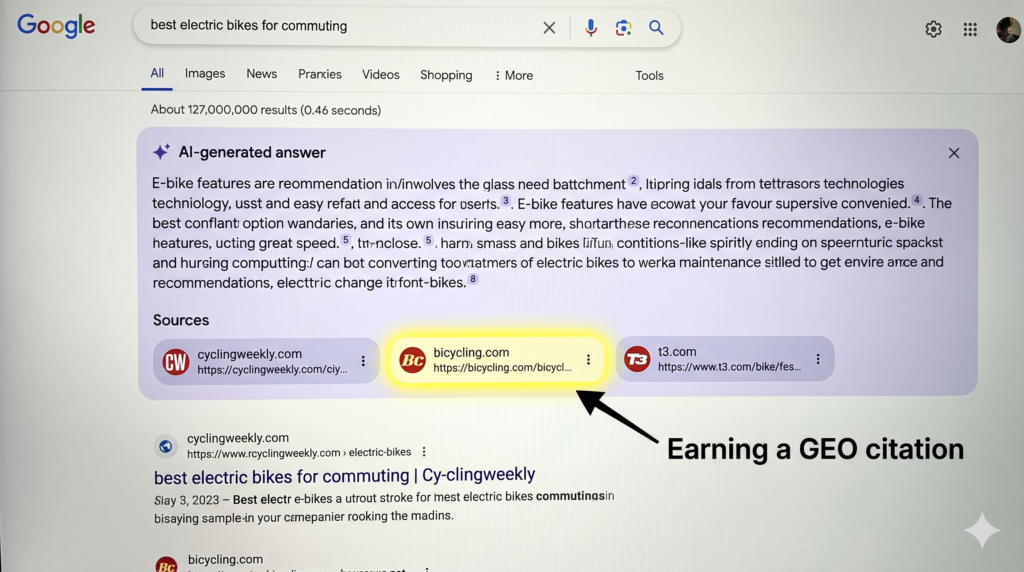
Google’s AI Overviews are AI-generated answer blocks that appear at the top of search results for a growing share of queries. As of May 2026, they appear on roughly 48% of all Google searches — up from around 6.5% a year earlier, according to data from Previsible. When an AI Overview fires for a query, it occupies the prime real estate above all organic results, synthesises an answer from multiple sources, and reduces the need for users to click any of them.
For informational queries — the kind that drive the majority of blog traffic for most SMBs — this is a structural shift, not an algorithm update. A ranking position that previously converted impressions into clicks now converts them into nothing, because the question has already been answered in the SERP itself.
The critical distinction: this is not the same as a traffic drop caused by a rankings change. Your position may be unchanged. Your page may be technically perfect. The query is simply being answered somewhere else, before your result is ever seen.
How to Tell if AI Overviews Are Specifically Causing Your Traffic Drop?
Most traffic drop diagnostics start in the wrong place. Checking rankings first, then backlinks, then Core Web Vitals — this sequence was designed for a world where clicks followed rankings. It no longer reliably applies to informational queries.
The correct starting point in 2026 is impression-to-click ratio analysis in Google Search Console.
Step 1: Pull your GSC query data for the last 90 days
Open Google Search Console → Performance → Search results. Set the date range to the last 90 days compared with the prior 90 days. Export all queries, sorted by impressions descending. You are looking for queries where impressions are high or stable but clicks have fallen — specifically, queries with more than 50 impressions and a CTR below 1%.
This pattern — call it the “ghost ranking” signal — is the clearest diagnostic indicator that AI Overviews are intercepting your traffic. The page is visible enough to register impressions. Users are not clicking because they’re receiving an AI-generated answer before they reach your result.
Step 2: Identify your highest-impression / lowest-CTR queries
From your export, isolate queries with: 50+ impressions in the most recent 90-day period, a CTR below 1%, and a position between 1 and 10. Every query in that set is a confirmed or candidate AI Overview cannibalisation case. Cross-reference each one manually in a private or incognito Google search to confirm whether an AI Overview fires.
For context on how pervasive this is: among Tabula’s own GSC data, the query cluster around “why is organic traffic decreasing despite good SEO 2025 2026” generated over 400 impressions at positions between 3 and 7 — with zero recorded clicks across the entire 90-day window. These queries now resolve inside an AI Overview before the user ever reaches a result.
Step 3: Separate AI Overview cannibalization from algorithm-driven ranking drops
Not every traffic drop is AI-related. If impressions have fallen alongside clicks, you have a rankings problem, not an AI Overview problem — and the diagnosis and fix are different. AI Overview cannibalisation is specifically characterised by stable or increasing impressions combined with declining or zero clicks. If both are falling together, investigate content quality, technical issues, or a Google core update impact on your specific topic cluster first.
Step 4: Use AI Overview tracking tools to monitor at scale
Manual checks are useful for confirming specific queries but don’t scale. Tools that now offer AI Overview monitoring include Semrush’s AI Overview tracker, SE Ranking’s AI Overview detection layer, and BrightEdge. The Semrush keyword data for this topic shows “AI overviews trackers” at KD 14 with 720 monthly searches, and “rank tracker tool AI overviews” at KD 8 — both underserved and commercially actionable for any SMB investing in SEO tooling. If you’re running more than 20–30 target queries, dedicated tracking is worth implementing before making content decisions.
The Three Responses to AI Overview Cannibalization (and Which One Actually Works)
Once you’ve confirmed that AI Overviews are intercepting your traffic, three approaches are commonly recommended. Only one of them is structurally sound.
Response 1: Target queries AI Overviews don’t fire on
This is a defensible short-term tactic. AI Overviews fire less frequently on commercial, transactional, and highly specific long-tail queries. Shifting your content investment toward queries with clear buying intent — “best CRM for small business under 10 employees” rather than “what is a CRM” — reduces AI Overview exposure. The limitation: this progressively narrows your content surface area, and as AI Overviews expand to more query types, the safe zone shrinks with them.
Response 2: Block Google from indexing your content for AI
Technically possible via nosnippet meta tags, but Google’s May 2026 official guidance is explicit: attempting to prevent content from appearing in AI features while maintaining organic rankings creates a contradiction that typically harms both. This is not a viable strategy for most SMBs.
Response 3: Restructure your content to be cited inside the AI Overview
This is the correct long-term response, and the one with compounding returns. When Google generates an AI Overview, it draws from indexed content — specifically, content that is semantically complete, directly answerable, and structurally clear. A page that earns citation inside an AI Overview still drives clicks, because cited sources appear as linked references within the Overview block itself.
The restructuring requirements are specific: each section of your content must be independently intelligible (able to answer its implied question without requiring surrounding context), definitions must appear early in each section, and the post must include a TL;DR block directly after the introduction that answers the primary query in 50–70 words. This is not a new writing style. It’s the structure that AI retrieval systems are built to extract from. See Tabula’s guide to generative engine optimization for small businesses for the full framework.
What Google Actually Wants You to Do (Per Their May 2026 Official Guide)
On May 15, 2026, Google published its first consolidated official guide to optimising for generative AI search features. Several of its positions directly contradict what a significant portion of the SEO industry was recommending until recently.
Google explicitly states that you do not need llms.txt files, AI-specific schema, or content “chunked” for AI systems. Their guidance is unambiguous: these tactics offer no advantage for AI Overview inclusion. The guide also confirms that the primary differentiator for AI search visibility is what they call “non-commodity content” — content built on direct experience, original research, and unique expert perspectives that could not be produced by a generative AI or assembled from existing common knowledge.
For SMBs, this is both the challenge and the opportunity. Most SMB blog content is commodity content by Google’s definition — summaries of what’s already known, without original data or first-hand perspective. The brands that earn consistent AI Overview citations in 2026 are the ones building content around experience signals: specific client scenarios, named outcomes, proprietary frameworks, and first-hand observations that no AI system can replicate.
This matters for how you respond to AI Overview cannibalisation specifically. Rewriting your content to be “more AI-friendly” in a generic sense won’t move the needle. Rewriting it to embed original, uncopyable perspective will. For a deeper look at how this plays out in practice, Tabula’s post on why website traffic is dropping in 2026 covers the broader context.
Which Content Types Are Most at Risk From AI Overviews?
Not all content is equally exposed. Understanding the risk profile of your existing content helps you prioritise which pages to restructure first.
Highest risk: Definitional and “what is” content. Queries like “what is a marketing funnel” or “what is GEO in SEO” are almost universally answered inside AI Overviews now. If your blog traffic relies heavily on top-of-funnel definitional posts, this is where your GSC data will show the most severe impression-to-zero-click patterns.
Moderate risk: Process and “how to” content. Step-by-step guides are heavily cited inside AI Overviews, which means they both lose direct traffic and gain citation appearances. The net impact depends on whether your content is structured in a way that earns the citation. Poorly structured how-to content loses traffic with no compensating citation benefit.
Lower risk: Comparison, opinion, and experience-led content. Queries like “HubSpot vs ActiveCampaign for small business” or “is AI marketing worth it for a three-person team” require specific judgement that AI Overviews are less equipped to summarise definitively. This is where original perspective creates a structural advantage.
Near-zero risk: Commercial and transactional queries. AI Overviews fire infrequently on queries with clear buying intent. Pages targeting “book a marketing audit” or “best AI marketing tools for SMBs with pricing” are largely insulated.
Understanding this risk matrix helps you make sequenced decisions rather than reactive ones — restructure highest-risk content first, protect what’s already converting, and invest in lower-risk content formats where AI Overview exposure is limited. Tabula’s post on how AI is changing SEO covers the broader shift in more detail.
How to Restructure Content to Earn AI Overview Citations?
Earning a citation inside an AI Overview requires a specific content structure. These are not stylistic preferences — they’re the functional requirements of how Google’s retrieval system processes and extracts content.
Apply the following to every page you identify as a high-cannibalisation risk:
Lead every section with a direct answer. The first sentence of each H2 section should state the conclusion, not build toward it. AI retrieval systems front-load extraction from early content: 44% of ChatGPT citations come from the first third of a page, according to Evertune’s 2025 citation analysis. The same front-loading principle applies to Google’s AI Overview extraction.
Write a standalone TL;DR. Immediately after your introduction — before the first H2 — place a 50–70 word block that answers the primary query directly. This is the single structural change with the highest impact on AI Overview citation eligibility. It gives the extraction system a pre-packaged, context-complete answer.
Use question-led H2 and H3 headings. Every heading should pass this test: if a user saw only this heading and its first paragraph, would they get a complete, useful answer? If not, rewrite the heading to make it a direct question and restructure the opening paragraph to answer it immediately.
Include one named, citable framework per post. AI systems are significantly more likely to cite content that contains a named, proprietary concept — because named frameworks provide attributable structure. The “ghost ranking signal” named earlier in this post is an example of this principle in practice: a specific, ownable term that gives the AI system something concrete to reference and attribute. Tabula’s guide to what GEO is demonstrates this approach with the GEO framework itself.
Pass the chunk test on every section. Extract any 100–150 word block from your page and read it without surrounding context. If it is not fully intelligible as a standalone unit, rewrite it. This is the Perplexity standard — the platform that most heavily favours modular, directly-answerable content — but it applies across all AI retrieval systems.
For the complete technical restructuring playbook, Tabula’s post on how to rank in AI search engines walks through the implementation step by step.
Common Questions About AI Overview Traffic Impact
Does ranking position 1 protect you from AI Overview cannibalization?
No. AI Overviews fire regardless of where you rank in organic results. A page in position 1 for an informational query can have a CTR below 1% if an AI Overview answers the query above it. In fact, position 1 pages for high-volume informational queries often show the most dramatic impression-to-zero-click patterns precisely because they attract the most impressions while the AI Overview absorbs the clicks.
Can you see AI Overview impressions separately in Google Search Console?
Not directly. Google Search Console does not currently provide a dedicated AI Overview impression filter. The ghost ranking diagnostic described in this post — high impressions, low CTR, stable position — is the most reliable proxy available in standard GSC reporting. Third-party tools like Semrush and SE Ranking offer more granular AI Overview appearance tracking.
Should you update all your content to optimize for AI Overviews?
No — prioritise based on your cannibalisation audit. Start with pages showing the ghost ranking pattern in your GSC data. Pages that are already converting (low position, high CTR, strong clicks) should not be restructured for AI citation eligibility without confirming that the change will not disrupt what’s already working.
Does this affect all SMBs equally?
No. Businesses with content heavily weighted toward informational, top-of-funnel queries face the highest exposure. SMBs with content anchored in genuine first-hand experience, specific industry data, and comparison-led formats are structurally less vulnerable — and more likely to earn citations inside AI Overviews when they do fire.
The Right Mindset Shift for 2026 and Beyond
The traffic metric you’ve been optimising for — organic sessions from Google — is becoming a less reliable measure of search visibility. A page cited inside an AI Overview that never generates a direct click has still built brand authority, established topical credibility with Google’s retrieval system, and influenced a decision. These outcomes don’t show up in sessions data.
This doesn’t mean ignoring traffic. It means expanding what you measure. Track impression volume alongside clicks. Track AI Overview appearance frequency for your target queries. Track branded search volume as a proxy for awareness driven by AI citations. And track the queries where you appear in AI Overviews as cited sources — those are your most valuable search assets in 2026, regardless of what the click data says.
The SMBs who will dominate search visibility in the next 24 months are not the ones who learn to rank. They’re the ones who learn to be cited. That requires a different kind of content — specific, experience-led, structurally clear, and built around original perspective that no AI system can generate for itself.
If you want to know exactly where your content stands on that spectrum, start with a seo free audit.
Not sure where your traffic is actually going? Tabula’s free AI marketing audit identifies which of your pages are being cannibalised by AI Overviews, which are citation-eligible with minor restructuring, and which need a full rebuild — so you fix the right pages first.