Your Marketing Isn’t Broken — It’s Blocked. Here’s How AI Fixes It.

Most small businesses don’t have a marketing problem. They have a bottleneck problem.
You’re producing content, running ads, posting on social, chasing leads — and somehow the results still feel disproportionate to the effort. According to Constant Contact’s 2025 SMB research, 56% of small business owners have an hour or less each day to spend on marketing, and 73% aren’t sure their current strategy is actually working. More troubling: only 18% of SMBs feel confident in the effectiveness of their marketing — down from 27% the year before.
That’s not a budget problem. That’s a systems problem.
The businesses breaking through this cycle aren’t necessarily spending more or hiring bigger teams. They’ve identified where their marketing gets stuck — the specific points where effort goes in and results don’t come out — and they’ve applied AI precisely at those pressure points. This post breaks down the five most common marketing bottlenecks SMBs face and exactly how AI addresses each one.
What Is a Marketing Bottleneck?
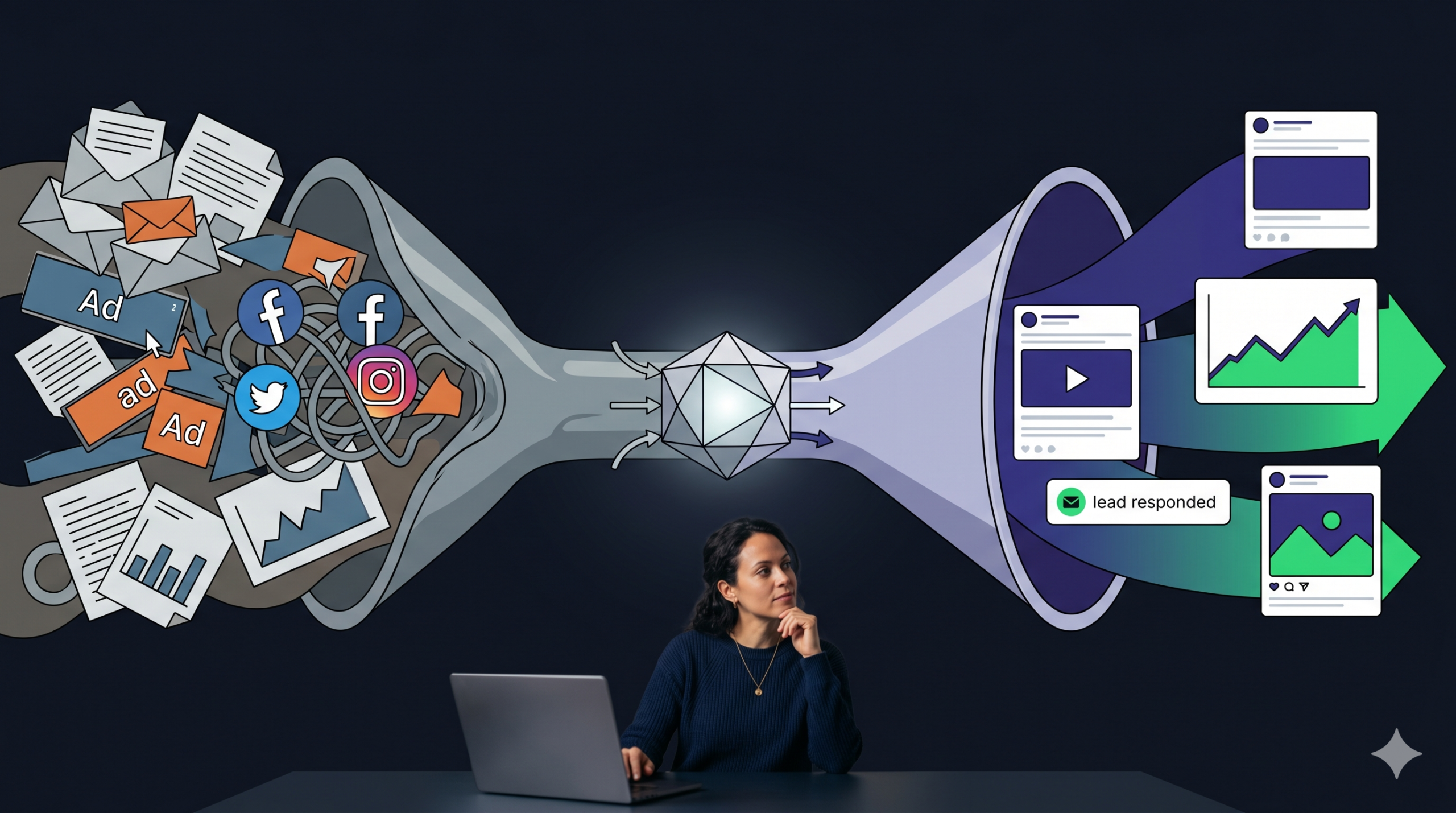
A marketing bottleneck is any point in your system where work slows down, stalls, or stops producing the outcome it should. Think of it like a pipe with a kink in it: water flows in, pressure builds, but output is weak. The problem isn’t the amount of water — it’s the kink.
For most SMBs running a team of two to ten people, bottlenecks tend to cluster in predictable places: content production, lead follow-up, data interpretation, channel management, and personalisation at scale. These aren’t exotic problems. They’re the same constraints showing up in businesses across every industry, every revenue bracket, every geography. The difference between the businesses that scale and the ones that stall is whether they’ve built a system that removes those kinks — or whether they’re still pushing harder on the same blocked pipe.
That’s where AI-powered marketing systems come in. Not as a collection of shiny tools, but as infrastructure that removes friction at each stage of your marketing operation.
Bottleneck 1: Content Production Is Slow, Inconsistent, and Draining Your Team
Ask most SMB owners what their biggest marketing frustration is, and content comes up immediately. Not because they don’t understand its value — they do. The problem is the operational reality of producing consistent, quality content when you’re also running a business.
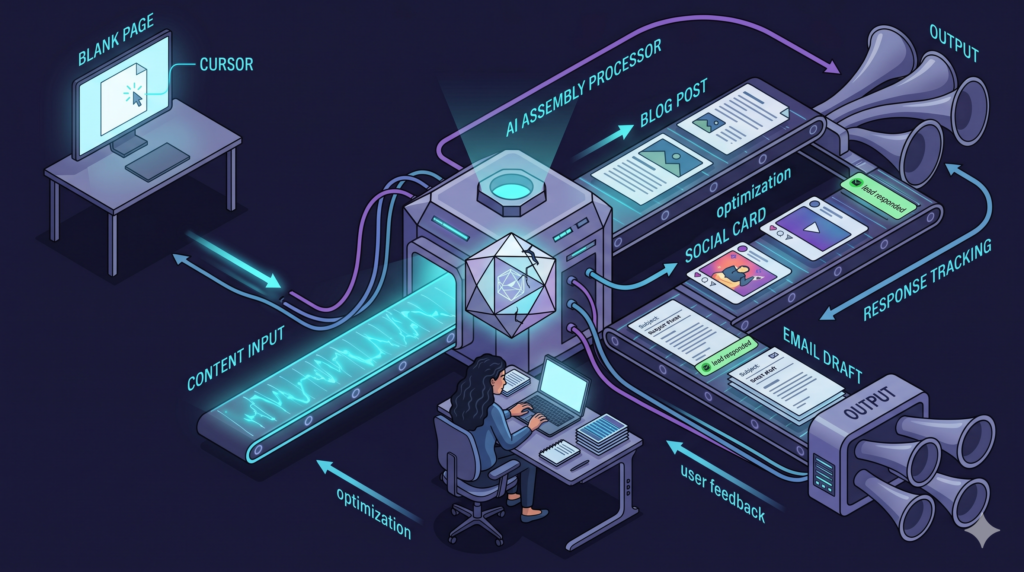
A single blog post takes research, drafting, editing, and optimisation. A week’s worth of social content requires ideation, copywriting, design direction, and scheduling. Multiply that across email, website copy, and ad creative, and you’re looking at dozens of hours of work every month for a team that doesn’t have dozens of hours to spare.
AI doesn’t eliminate the need for human editorial judgment — it removes the labour-intensive parts that precede it. With the right AI content system in place, your team spends time on strategy and refinement rather than blank-page paralysis and first-draft slog. Briefs become outlines. Outlines become drafts. Drafts get edited, not written from scratch.
The important distinction is that AI-generated content without a system produces inconsistent output that sounds like every other business. An AI marketing system with documented brand voice, content frameworks, and editorial workflows produces content that sounds like you — at the speed of a full content team.
For SMBs that want to understand what consistent content production actually looks like in practice, Tabula’s guide on AI content marketing consistency is worth reading alongside this.
Bottleneck 2: Leads Go Cold Before Anyone Follows Up
Speed matters more in lead conversion than almost any other variable. Research from the Harvard Business Review found that businesses that responded to leads within an hour were seven times more likely to qualify them than those that waited even 60 minutes longer. For an SMB with a small team juggling operations, client delivery, and sales, that window closes before anyone notices it opened.
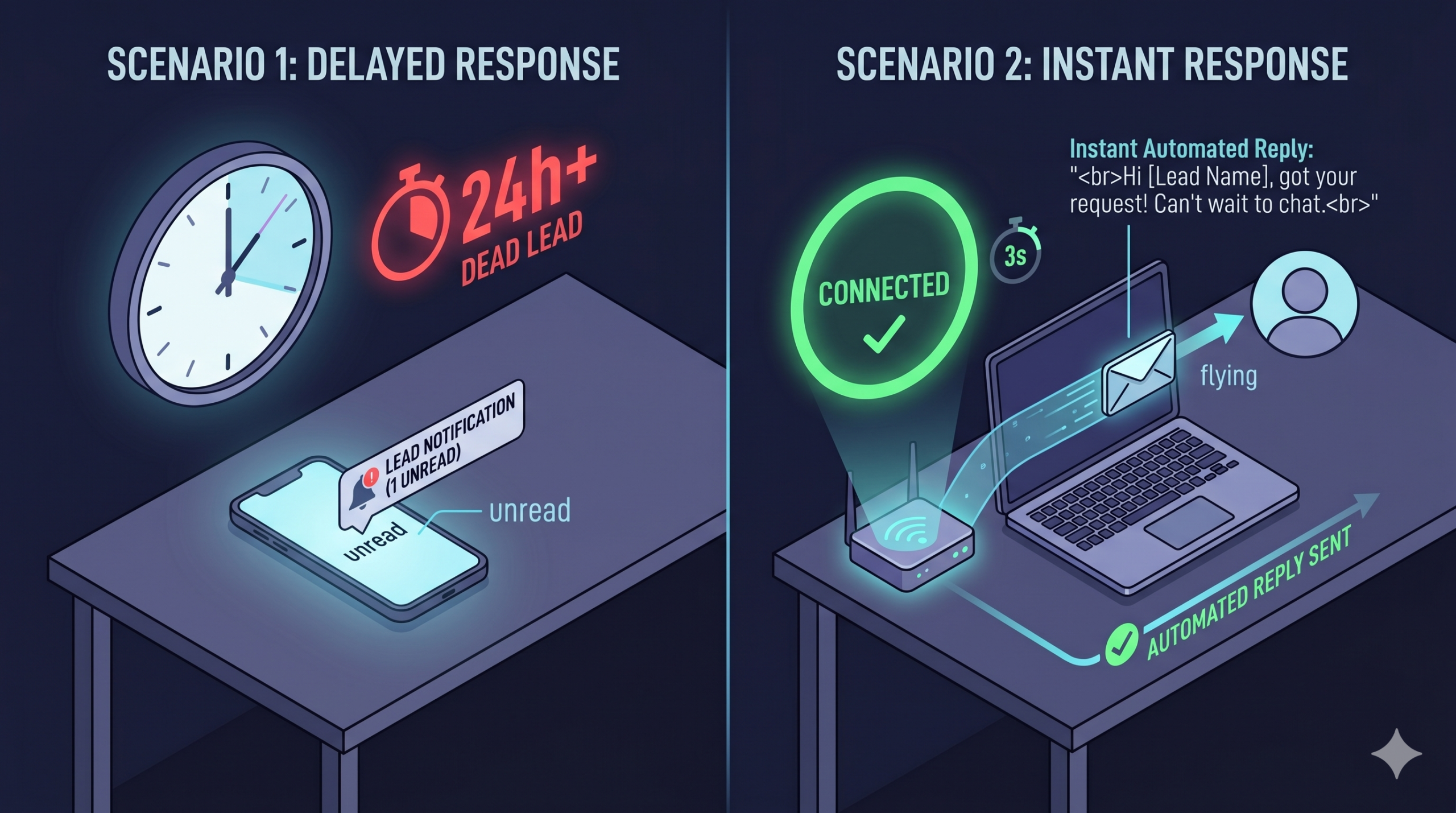
The result is a slow, leaking pipeline. Leads come in from your website, social media, paid ads, or organic search — and they sit. They get a follow-up 24 or 48 hours later. By then, they’ve moved on, or worse, a competitor got there first.
AI-powered automation addresses this without requiring a dedicated sales team. Automated lead nurturing sequences — triggered the moment someone submits a form, downloads a resource, or interacts with your content — can respond instantly, qualify intent, and route serious prospects to a human conversation at exactly the right moment. The AI handles the initial contact and the follow-up cadence; your team handles the close.
This is where AI lead generation tools stop being a novelty and start being operational infrastructure. Tabula has written extensively on AI lead generation tools that work within a wider system rather than as standalone point solutions.
The mistake most SMBs make here is treating this as a CRM problem. It isn’t. It’s a system problem. If you want to understand how CRM and marketing automation should be integrated to support this, Tabula’s guide on CRM and marketing integration gives you a practical framework.
Bottleneck 3: You Can’t Tell What’s Actually Working
Twenty-three percent of SMBs say their number one marketing frustration is not knowing what’s driving results, according to Constant Contact’s 2025 data. That’s not surprising. Most small businesses are running activity across four or five channels with no unified view of performance. They’re looking at Instagram insights here, Google Analytics there, an email open rate somewhere else — and trying to form a coherent picture of what to do next.
This isn’t an analytics problem. It’s an attribution problem. And attribution breaks down when your data lives in disconnected tools with no consistent logic connecting them.
AI-powered analytics changes this by doing two things simultaneously. First, it aggregates performance data across channels into a single view. Second, it identifies patterns and anomalies that a human reviewing fragmented dashboards would miss — correlations between content types and conversion rates, optimal send times for your specific audience, which paid channels are driving actual revenue versus vanity traffic.
For SMBs, this means making decisions based on real signal rather than gut feel. If your SEO content is quietly driving 40% of your qualified leads but your team is spending 70% of its time on social media, AI analytics surfaces that misalignment. That’s not a small insight. That changes how you allocate time and budget.
Understanding how AI helps with SEO and data-driven marketing as connected disciplines — rather than separate activities — is central to removing this bottleneck.
Bottleneck 4: Managing Multiple Channels Is Eating Your Week
Multi-channel marketing is the expectation now, not the exception. Your customers are on Instagram, searching on Google, reading emails, and watching video. Being present and consistent across all of those channels with a lean team is operationally brutal.
The typical SMB marketing workflow without AI looks like this: decide what to post, write the copy, find or create an asset, upload it to the right platform, schedule it, monitor it, respond to comments, then do the same tomorrow for a different channel. Each channel has its own format requirements, its own algorithm logic, its own best practices. Managing this manually is how marketing becomes a bottleneck rather than a growth engine.
AI addresses channel management at two levels. The first is production: repurposing a single piece of content — a blog post, a podcast transcript, a case study — into platform-specific formats across email, social, and paid simultaneously. The second is optimisation: AI scheduling tools that analyse your historical engagement data to post at the times your specific audience is most active, rather than following generic advice about the “best time to post.”
The result is not just time saved. It’s consistency that builds brand recognition over time — which is ultimately what drives organic growth. Businesses that understand multi-channel marketing strategy as a system rather than a collection of separate activities are the ones that compound their efforts rather than fragment them. Tabula’s organic social media services are built on exactly this principle.
Bottleneck 5: Your Marketing Can’t Personalise at Scale
Personalisation used to be a nice-to-have for big brands with enterprise budgets. It’s now a baseline expectation from customers at every level. McKinsey research consistently shows that personalisation drives significant revenue uplift — and the gap between businesses that personalise and those that don’t is widening.
For an SMB, personalisation at scale sounds like an impossible ask. You don’t have a CRM team. You don’t have a data science function. You’re sending the same email to your entire list because segmenting it would take hours you don’t have.
AI closes this gap directly. With the right system, your emails can be segmented and personalised based on behaviour — what someone has clicked, downloaded, purchased, or ignored. Your website content can surface different messaging based on where a visitor came from. Your ad creative can be dynamically adjusted based on the audience segment being targeted.
The key word here is system. This doesn’t happen by installing a single tool. It happens when your CRM, your content workflows, your email platform, and your analytics are connected — with AI operating across all of them, making personalisation decisions based on real data rather than manual rules. Tabula’s work on AI email personalisation and customer engagement tools addresses this in practical detail.
Why AI Alone Doesn’t Fix Bottlenecks — Systems Do
Here’s the part most content on this topic glosses over: installing AI tools doesn’t remove bottlenecks. It can create new ones if those tools aren’t connected within a coherent system.
Half of SMBs are now using AI for marketing, according to Constant Contact’s 2025 research. Yet marketing confidence has fallen, not risen. The businesses that are getting results from AI aren’t necessarily using more tools — they’re using AI within a structured system that maps clearly to their business goals.
That system has four stages: Build, Run, Train, and Own. You build the infrastructure — the connected stack, the workflows, the content architecture. You run it consistently enough to generate real data. You train your team to operate it with confidence. And then you own it — meaning your marketing capability belongs to your business, not to an agency contract or a consultant who holds the keys.
This is the difference between marketing that perpetually feels like a bottleneck and marketing that becomes a reliable growth engine. The tools are widely available. The system is what most SMBs are missing.
If you want to understand what the right AI-powered marketing setup looks like for a business your size, Tabula’s full range of marketing services is a good place to start. And if you’re specifically thinking about how search and AI discovery fit into your growth strategy, Tabula’s professional SEO services and GEO content category cover the technical side in detail.
The five most common marketing bottlenecks for SMBs are slow or inconsistent content production, delayed lead follow-up, unclear attribution across channels, manual multi-channel management, and an inability to personalise at scale. Each of these slows marketing output or reduces its effectiveness and all five can be addressed with a properly structured AI marketing system.
No — and the businesses getting the best results from AI aren’t trying to replace their teams. AI handles the repetitive, time-intensive parts of marketing: first drafts, scheduling, data analysis, automated follow-ups. Human judgment remains essential for strategy, brand voice, and creative direction. The goal is a team that works faster and makes better decisions, not a team that disappears.
Costs vary significantly depending on the tools and level of integration. Many capable AI marketing tools start at $20–$50 per month. A properly integrated system — CRM, automation, content, and analytics connected with AI capabilities — typically runs between $200 and $800 per month for an SMB, depending on team size and complexity. The more meaningful number is the time and revenue cost of not addressing the bottlenecks.
Using AI tools means adopting individual products that solve isolated problems. Building an AI marketing system means connecting those tools within a structured workflow — with clear goals, consistent data flow, and a team that knows how to operate the whole. The former can create new complexity; the latter removes it.
Most SMBs see operational improvements — faster content production, quicker lead response, cleaner reporting — within the first 30 to 60 days of implementing an AI system. Measurable revenue impact typically builds from month three onward, as the system generates enough data for meaningful optimisation.
The Bottleneck You Can’t Afford to Ignore
Every month you run marketing with unresolved bottlenecks is a month of compounding inefficiency. The leads that go cold don’t come back. The content that doesn’t get produced doesn’t build authority. The data that isn’t connected doesn’t produce insights. These aren’t dramatic failures — they’re quiet ones, the kind that don’t announce themselves until growth stalls and you’re left trying to figure out why.
The businesses that will own their marketing over the next three years aren’t the ones with the biggest budgets. They’re the ones that built systems early, removed the friction deliberately, and used AI to do the work that was always getting in the way.
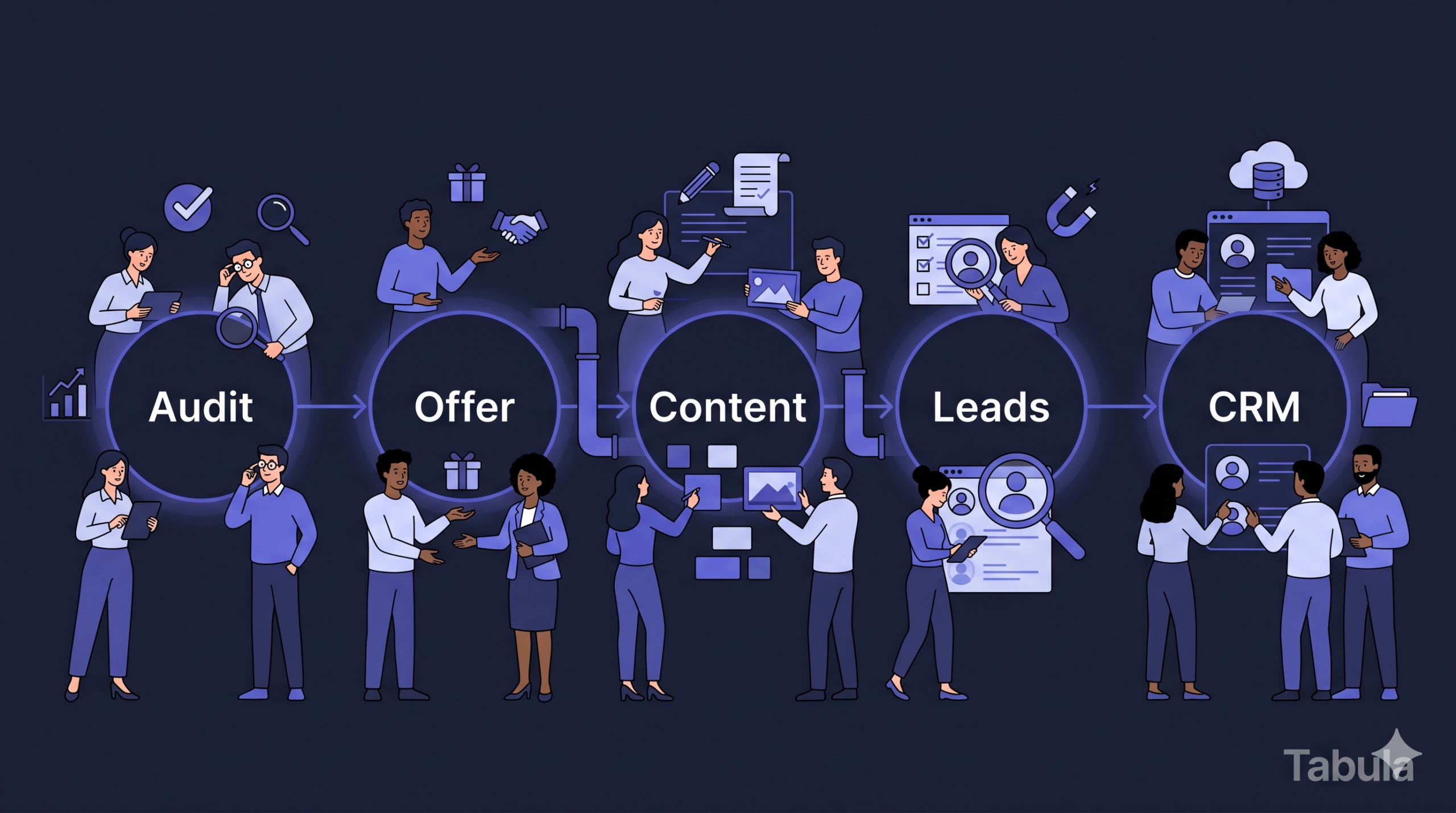
If you’re ready to stop working around your bottlenecks and start removing them, get in touch with Tabula. We’ll audit your current marketing setup and show you exactly where the kinks are — and what an AI marketing system built around your business would look like.
Your competitors are figuring this out. The window to build before they do is still open — but it won’t stay that way.