
How to Get Your Small Business Found in ChatGPT and Perplexity Answers?

Your competitor just showed up in a ChatGPT answer. A potential customer asked which marketing agency to hire, and your competitor’s name appeared in the response.
Yours did not. That is not random.
There are specific, fixable reasons why some businesses appear in AI search answers and others do not.
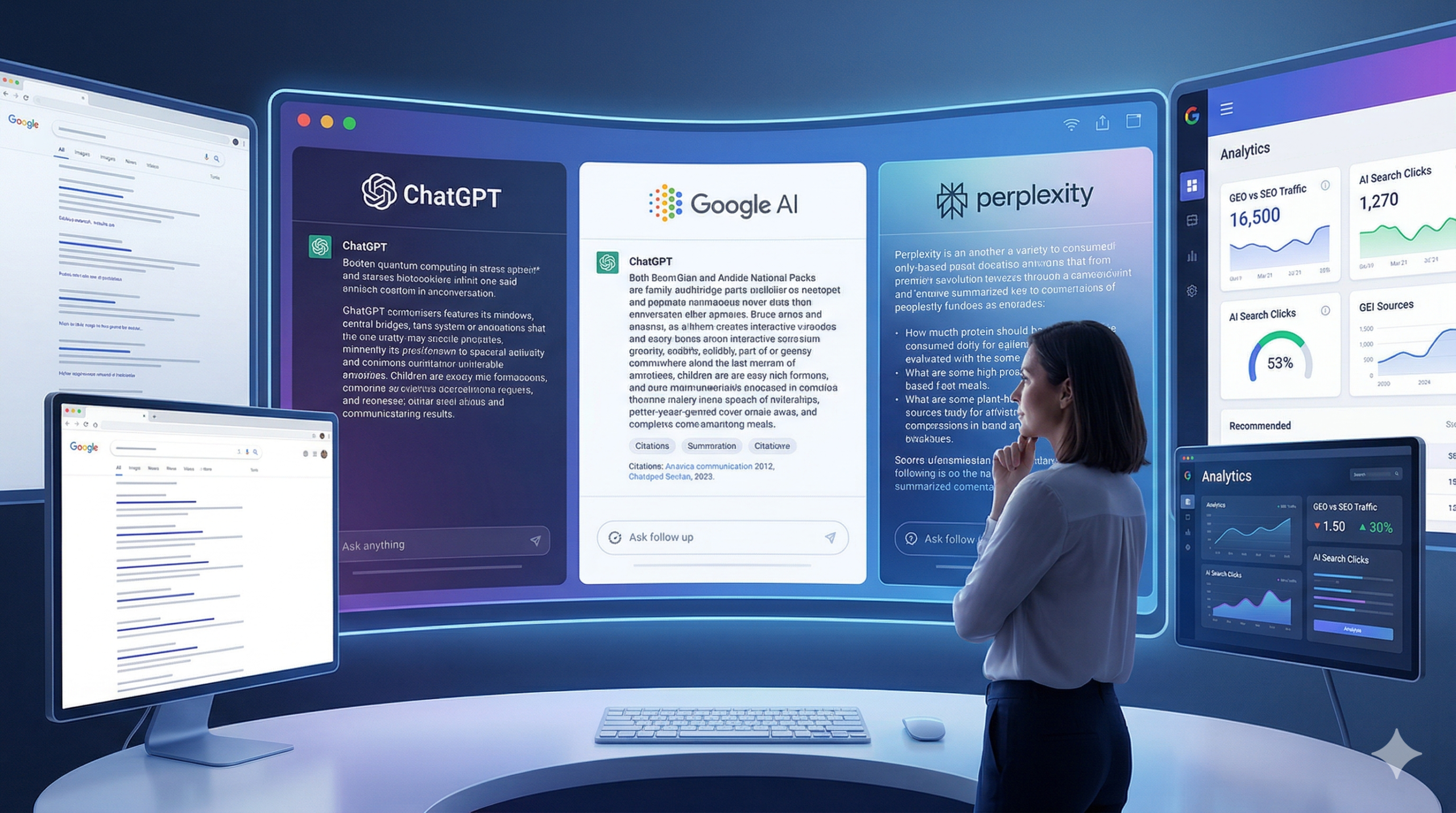
ChatGPT alone handles over 1.8 billion monthly queries, according to Athenic’s 2026 research, growing at 340% year-on-year. Combined with Perplexity and Google AI Overviews, the total reaches roughly 15 billion queries monthly.
The businesses appearing in those answers are getting free, trusted recommendations in front of buyers who have already decided they want help.
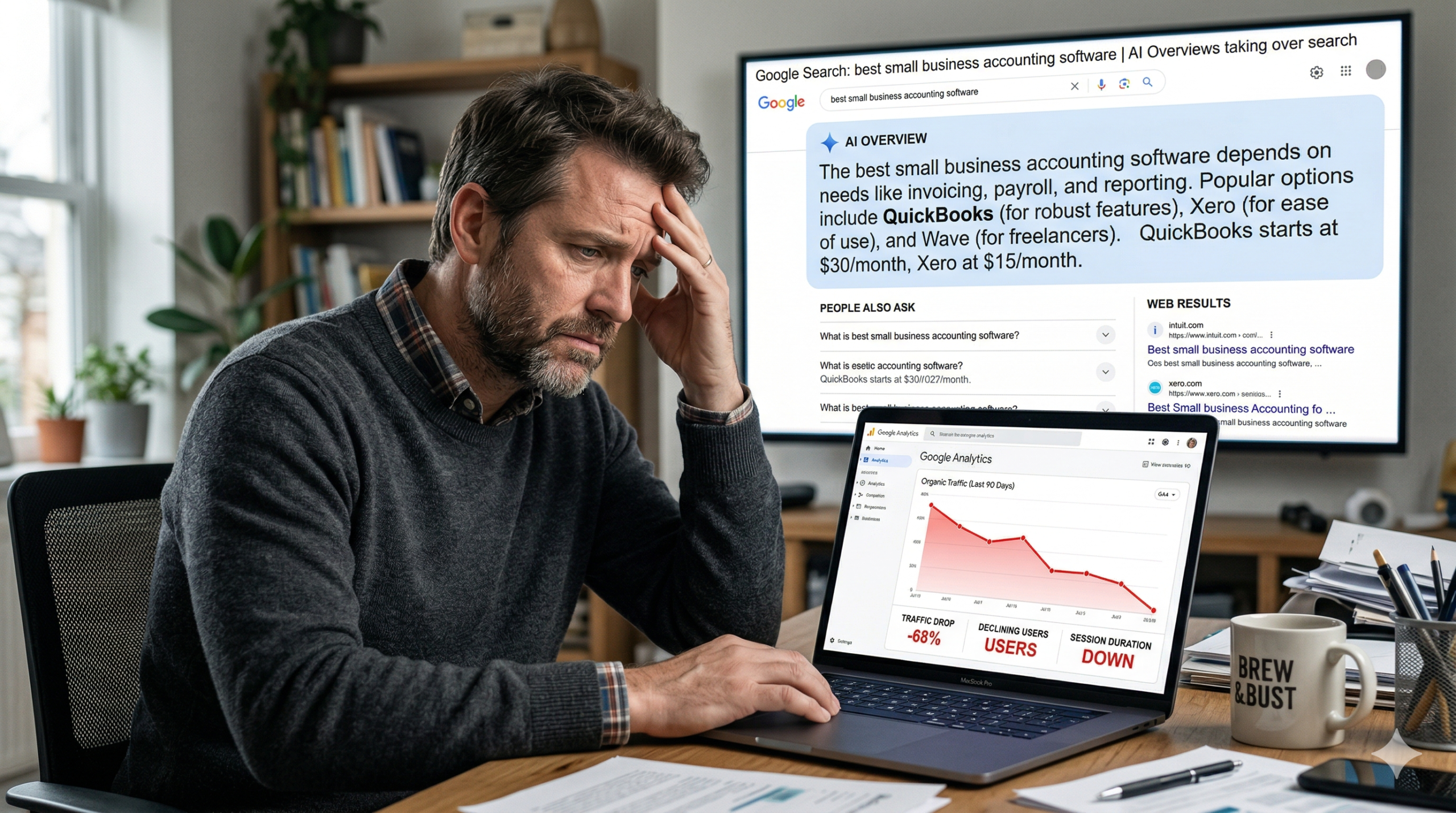
There is no paid placement. Citations are earned, not bought. The good news is that the signals AI tools use to decide who to cite are learnable and buildable, no matter how new your website is. If you have noticed your website traffic dropping in 2026, this is the same underlying shift.
How ChatGPT and Perplexity Actually Decide Who to Cite?
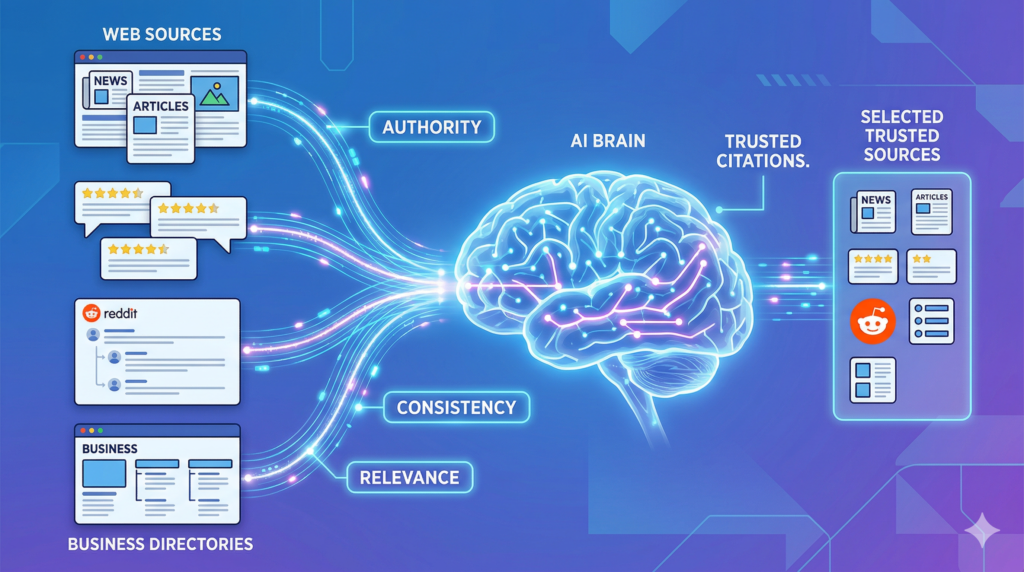
AI search engines do not rank pages the way Google does. They read multiple sources, synthesize an answer, and cite the ones they found most authoritative, clear, and directly relevant to the question.
- Each platform has different source preferences: ChatGPT cites around three sources per answer and leans heavily on Wikipedia, Reddit, and well-known publications. Perplexity tends to cite more sources and favors niche industry directories and review platforms. Gemini pulls from brand-owned websites more than the others, rewarding sites with clear structure and schema markup. You do not need to win all three at once. Start by being citable on one.
- Authority signals matter more than age: AI models do not care how long your business has existed. They care whether your brand appears consistently and credibly across the web. A new business with structured content and clear positioning can appear in ChatGPT answers faster than an older business with a vague, inconsistent online presence.
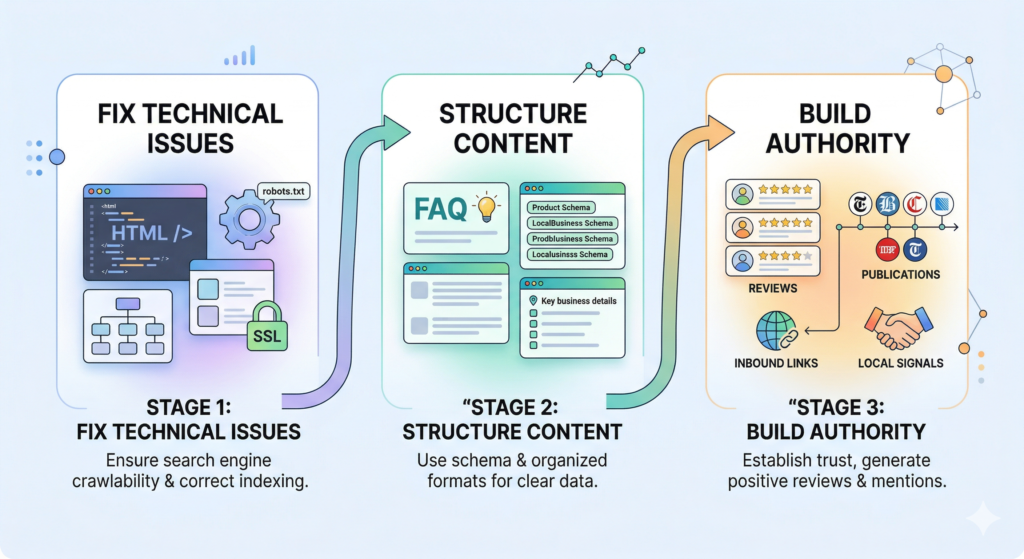
There is no shortcut, but there is a system A commercial lending company referenced in ROI Amplified’s research went from invisible to receiving 15% of all sales calls through ChatGPT — without spending anything on ads. The customers never even opened Google. That result came from building the right AI search visibility signals deliberately, not from luck.
Step 1 — Check Whether AI Can Even Find You Right Now
Before optimizing anything, find out where you actually stand. Most business owners skip this step and waste time fixing the wrong things.
- Test your visibility in 5 minutes: Open ChatGPT with web browsing enabled, Perplexity, and Google with AI Overviews on. Search your core service plus your city — for example, “best AI marketing agency in Toronto” or “who should I hire for SEO in Canada.” Note which businesses appear. If yours is not there, look at the content structure of the ones that are.
- Check your robots.txt file: Go to yourdomain.com/robots.txt. If you see “GPTBot: Disallow” or “PerplexityBot: Disallow,” your entire site is blocked from those AI engines. Per experts 2026 analysis, this single technical issue makes businesses completely invisible to ChatGPT and Perplexity regardless of how good their content is. Fix it before doing anything else.
Check for NAP consistency: Your business name, address, and phone number need to match exactly across your website, Google Business Profile, LinkedIn, and any directory listings. AI engines cross-reference these sources. Inconsistencies reduce their confidence in your brand and lower citation frequency.
Step 2 — Structure Your Content So AI Can Cite It
The content that gets cited in AI answers shares a specific set of characteristics. None of them require technical skills. They all require intention.
- Answer questions directly and immediately: AI search engines favor content that answers a question in the first sentence of a section, not the third paragraph. Every H2 on your website should either be a question or clearly signal what answer follows. Start each section with the conclusion, then support it.
- Add FAQ sections to every page: FAQ sections are the highest-cited content format in ChatGPT search optimization. Each answer needs to be self-contained — readable without surrounding context. Write answers between 50 and 80 words. AI tools pull FAQ answers as standalone responses when a user asks a matching question.
- Use clear, named frameworks: Generic content gets absorbed by AI and paraphrased without credit. Content that names a specific concept gets cited. At Tabula, we call our approach the Tabula GEO Framework — named structures are more citable than unnamed processes.
Add schema markup JSON-LD schema for Organization, Service, and FAQ tells AI crawlers exactly what your business does and what questions your content answers. Gemini in particular rewards sites with clean schema implementation. This is a one-time setup that pays dividends across every AI search platform.
Step 3 — Build Your Presence Beyond Your Website
Your website is one signal. AI tools build their picture of your business from dozens of sources. The businesses that appear consistently are present in more than one place.
- Get mentioned in industry publications: AI models weight third-party coverage heavily. A mention in a recognized industry publication carries far more authority than any self-published content. Guest articles, expert commentary, and podcast appearances all build the external signal AI tools look for to confirm your ChatGPT business visibility.
- Participate in indexed communities: Perplexity cites Reddit in 6.6% of its responses. LinkedIn posts, Quora answers, and Reddit contributions written with genuine expertise are all indexed and can surface in AI search results. Pick one community where your customers actually gather and contribute regularly.
Collect and publish reviews on the right platforms: ChatGPT relies heavily on third-party consensus from platforms like G2, Trustpilot, and Google Reviews. Perplexity trusts customer reviews in niche industry directories. Encourage clients to leave detailed, specific reviews that mention what problem you solved and how. Vague five-star reviews carry less signal than a specific paragraph describing the result.
How Long Does This Take?
This is the question every business owner asks. The honest answer depends on where you are starting from.
- Technical fixes work immediately: Fixing robots.txt and adding schema markup produces results within days of your next AI crawler visit. These are the highest-leverage changes because they remove blockers, not just add signals.
- Content changes take weeks. New FAQ sections and restructured pages typically begin appearing in AI answers within two to four weeks of indexation, according to Athenic’s client research. This is significantly faster than traditional SEO, which can take months.
Building external signals takes longer: Third-party mentions, directory listings, and publication coverage compound over time. Businesses that start building this layer now will have a meaningful advantage over competitors who start in six months. The window to be an early mover in AI search for most SMB niches is still open in 2026.
Getting found in ChatGPT and Perplexity is not about gaming a system. It is about making your business easy for AI tools to understand, verify, and recommend. The steps above are the same fundamentals that build a real AI marketing system — clarity, structure, consistency, and authority built over time.
Most businesses in your space have not started this yet. The SMBs that show up in AI answers six months from now are the ones building these signals today.
If you want to know exactly how visible your business is in ChatGPT, Perplexity, and Google AI Overviews right now, Tabula’s free SEO and GEO audit tells you where you stand and what to fix first. No obligation.
Frequently Asked Questions
Start by checking your robots.txt file to confirm GPTBot is not blocked. Then restructure your website content so every page opens with a direct answer to a specific question, includes a FAQ section with self-contained answers, and uses schema markup. Build consistent mentions across third-party directories and review platforms. ChatGPT cross-references multiple sources before deciding who to cite.
No. According to Athenic’s 2026 research, there is no paid placement in ChatGPT, Perplexity, or Claude. Citations are editorial decisions made by the AI model based on authority, content structure, and relevance to the query. You cannot buy your way into an AI answer. You have to earn it by building the right signals.
Google ranks pages and shows links. ChatGPT synthesizes an answer from multiple sources and cites two to three of them. You do not need to rank first — you need to be recognized as a credible, clearly structured source on a specific topic. A smaller, well-structured website can outperform a large competitor if its content is more directly answerable.
Technical fixes like unblocking AI crawlers and adding schema markup take effect within days. Content improvements such as FAQ sections and restructured pages typically begin surfacing in AI answers within two to four weeks of re-indexation. Building external signals through third-party mentions and reviews takes one to three months of consistent effort.
FAQ sections are the most frequently cited format in AI answers. Each FAQ answer should be 50 to 80 words and fully self-contained — meaning it makes complete sense without any surrounding context. Named frameworks and step-by-step processes also perform well because AI tools can reproduce them as structured answers rather than paraphrasing vague advice.
Yes, indirectly. ChatGPT and Perplexity cross-reference your business across multiple sources to confirm credibility. A complete, accurate Google Business Profile with consistent NAP details and recent reviews increases the number of data points AI tools can verify. Inconsistencies between your profile and your website reduce the confidence AI models have in your brand.
SEO (Search Engine Optimization) focuses on ranking in Google by building page authority, backlinks, and keyword relevance. GEO (Generative Engine Optimization) focuses on getting cited by AI answer engines like ChatGPT and Perplexity. GEO prioritizes content structure, named frameworks, FAQ formatting, and third-party credibility signals. Both are worth building, and many of the fundamentals overlap.
Tabula’s professional SEO services include a free GEO audit that shows exactly how visible your business is across ChatGPT, Perplexity, and Google AI Overviews. From there, Tabula builds the content structure, schema markup, and external presence signals that earn AI citations. The goal is a system your business owns — not ongoing dependency on an agency.