
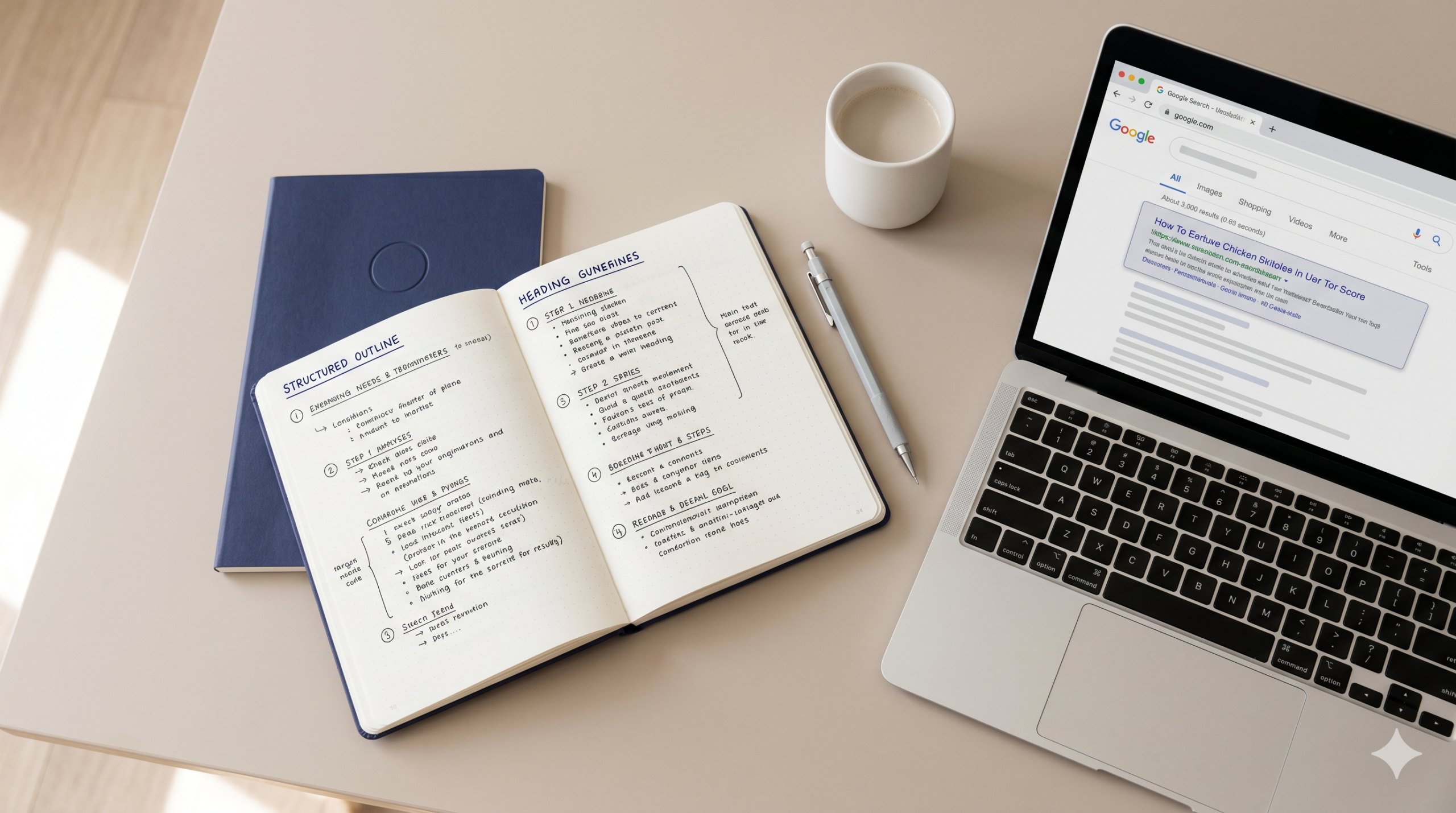
How to Write a Blog Post That Actually Ranks on Google?

You’ve published a dozen posts. Maybe more. You’ve done everything you were told picked a keyword, written something useful, hit publish and the traffic still isn’t coming. The posts sit there, invisible, while competing pages from brands with bigger budgets occupy every slot you wanted.
Here’s what most SMB blog guides won’t tell you: the problem usually isn’t the writing. It’s the architecture. Google doesn’t reward content that’s “good enough.” It rewards content that’s structurally engineered to answer a specific question better than anything else on the internet and increasingly, so do AI tools like ChatGPT and Perplexity.
By the end of this guide, you’ll know exactly how to plan, structure, write, and optimise a blog post that competes for page-one rankings and earns citations in AI-generated answers. Not theory. A repeatable system.
Why Most SMB Blog Posts Never Rank?
The average blog post published by a small business gets fewer than 10 organic visits per month. That’s not a content quality problem. It’s a structural one.
Three failures kill most SMB blog rankings before the post even has a chance. The keyword is too broad or misaligned with what the page actually delivers. The structure doesn’t match what Google has already decided to reward for that query. And the post exists in isolation no internal links pointing to it, no topical cluster supporting it.
Google’s ranking systems have one job: find the most helpful, credible, and well-structured answer for a given search. A post that covers a topic vaguely, skips proper heading hierarchy, and sits orphaned on a blog archive is the last thing those systems want to surface. If your posts aren’t ranking, the fix is almost never “write better.” It’s “build smarter.”
Step 1: Choose the Right Keyword Before You Write a Word
The keyword you target is the single most consequential decision in the entire process. Get it wrong and no amount of great writing recovers the post.
Target informational, long-tail keywords. These are specific, multi-word phrases — like “how to write a blog post that ranks on Google” rather than “SEO tips.” Long-tail keywords carry lower competition, clearer search intent, and significantly higher chances of ranking for a site that isn’t already a domain authority powerhouse.
How to validate a keyword before committing to it:
- Search it on Google and study the top five results. Note their format, heading structure, and approximate word count. This is what Google has already decided the reader wants.
- Check whether the intent matches what you can deliver. A query expecting a step-by-step guide won’t reward an opinion piece.
- Confirm volume and difficulty in a tool like Google Search Console, Ahrefs, or Semrush. For newer sites or blogs without strong domain authority, target keywords with a difficulty score under 40.
- Look at the “People Also Ask” box. Each PAA question is a section Google has flagged as important to the same reader and potential H2 material for your post.
For a practical breakdown of this process tailored to small businesses, Tabula’s keyword research guide for SMBs walks through each stage with real examples.
One rule to internalise: one post per target keyword. Publishing multiple posts targeting the same term splits your authority and creates keyword cannibalization a problem that actively suppresses rankings. Common SEO mistakes small business owners make covers this and several other structural errors worth auditing if your existing content isn’t performing.
Step 2: Engineer the Structure Before You Open a Document
Ranking posts aren’t written. They’re engineered. The structure determines performance more than the prose does and structure should be planned before a single sentence is drafted.
Start with your H2s. Each major heading should read like a standalone search query. If someone typed your H2 into Google, would the content beneath it directly answer what they’d expect? If not, rewrite the heading until it does. Google’s AI Overviews frequently pull individual sections from posts not the whole article. Every section must be able to stand on its own.
Determine the right word count based on competitive reality, not intuition. Study the top-ranking pages for your keyword and match or exceed their depth. For informational queries targeting awareness-stage readers the majority of SMB blog topics 1,500 to 2,500 words is typically the right range. Decision-stage content, like comparison guides or case studies, can often perform at 800 to 1,500 words with higher conversion density.
Plan your internal links before writing. Know which existing posts you’ll reference and where they’ll appear naturally in the content. Internal linking is one of the most underused SEO levers available to small businesses it signals topical authority, distributes equity to newer posts, and keeps readers moving through your site. Minimum three internal links per post. Maximum five or six before it starts to feel forced.
Step 3: Write an Introduction That Earns the Read
Most blog introductions lose readers in the first three sentences. They open with broad context, explain what the article covers, and promise value that a generic piece could also claim. Google’s quality systems and real human readers penalise this pattern.
A high-performing introduction does three things fast. It names the dominant frustration behind the search query, in specific rather than generic terms. It acknowledges what the reader has likely already tried. And it delivers a precise promise: not “you’ll learn about SEO” but “by the end of this, you’ll know the exact heading structure, keyword placement, and GEO signals that determine whether your post ranks.”
One structural rule worth treating as non-negotiable: open the post with a clear, direct statement about what the topic is or why it matters. AI tools ChatGPT, Perplexity, Gemini index the opening paragraph as the definitional entry point for the topic. A crisp, authoritative first paragraph is also your primary citation surface for AI Overviews.
Step 4: Optimise On-Page SEO Elements with Precision
On-page SEO is not keyword stuffing. It’s placing your primary keyword in the specific locations Google’s systems are trained to look and doing so in a way that reads naturally to a human.
Primary keyword placement checklist:
- H1 heading: contains the keyword, under 70 characters
- First 100 words of the introduction: keyword appears naturally, not forced
- At least one H2 heading: keyword or a close variant used in context
- Meta title: under 60 characters, keyword near the front
- Meta description: 140 to 155 characters, keyword present alongside one supporting term
- URL slug: short, hyphenated, keyword-rich (e.g.
/blog/how-to-write-a-blog-post-that-ranks)
Beyond placement, two on-page elements are consistently under-optimised by SMB blogs. Image alt text every image should carry a descriptive alt attribute that includes relevant keywords where natural. And heading hierarchy H1 to H2 to H3, with no levels skipped. Gaps in heading hierarchy confuse crawlers and suppress the structured data signals Google uses to evaluate topical authority.
For a deeper breakdown of how AI systems specifically interact with on-page SEO signals, how AI helps with SEO explains the mechanics in practical terms.
Step 5: Build Internal Links That Create Topical Authority
A single blog post, no matter how well written, does not build domain authority on its own. It builds it as part of a deliberate content architecture a cluster of related posts that collectively signal to Google that your site has comprehensive, credible coverage of a topic.
The framework is straightforward: every post you publish should link to at least one pillar page or cornerstone piece of content on your site. And when you publish something new, go back to relevant older posts and add a contextual link pointing to the new content. This “link injection” approach passes existing authority to new pages immediately, rather than waiting for external links to accumulate.
Anchor text must be descriptive. “Click here” and “read more” are wasted opportunities. Use the topic itself as the anchor: “how to structure a content calendar” or “why your SMB blog isn’t getting traffic.” The anchor text is a relevance signal treat it as one.
If you’re starting to think about this at a site architecture level, building a GEO-optimised content strategy and understanding how multi-channel marketing connects content are worth reading alongside your on-page SEO work.
Step 6: Add GEO Signals to Get Cited in AI Tools
Search behaviour has shifted. A growing share of queries particularly informational ones are now answered directly by AI tools before the reader ever reaches a search results page. For SMB blogs, this creates a new optimisation layer: Generative Engine Optimisation, or GEO.
GEO is the practice of structuring content so that AI systems like ChatGPT, Perplexity, and Google’s AI Overviews can extract, understand, and cite it in generated answers. According to research published in 2024 by Princeton, Georgia Tech, and the Allen Institute for AI, content that includes named citations, statistics with sources, and quotable definitions sees citation rates in AI answers increase by up to 40% compared to content without these signals.
The five GEO signals to include in every post:
- A definitional paragraph at the start of each major section. Two to three sentences, under 60 words, leading with the direct answer. AI Overviews pull these sections verbatim.
- Named frameworks or proprietary concepts. If you introduce a process or model, name it. Named frameworks are citable in a way that generic advice is not.
- A FAQ section with five to eight questions. Write questions exactly as a reader would type them. Answers should lead with the direct response in the first sentence.
- Specific claims with sources and years. Vague assertions are ignored by AI systems. Precise, attributed data points are cited.
- Schema markup. Implement Article, HowTo, and FAQPage schema via JSON-LD. This directly feeds structured data to search engines and AI crawlers.
For a comprehensive breakdown of GEO specifically for small businesses, Tabula’s guide to Generative Engine Optimisation and what GEO actually means in practice are the two most thorough resources currently available. Understanding E-E-A-T and why it matters is the complementary trust signal layer that works alongside GEO.
Step 7: Write Body Sections That Earn Featured Snippets
Featured snippets — the boxed answers that appear above organic results are not luck. They are the result of specific structural choices that match what Google has determined a reader needs for a given query.
For how-to queries like this one, numbered steps under a single H2 heading are the highest-probability snippet format. Each step should open with an action verb and be self-contained enough to be understood without reading the step before it. For definition queries, a standalone paragraph of under 50 words that opens with a direct answer to “what is X” is the target format. For list queries, a structured unordered list under a clear heading performs best.
Every H2 section should also end with a micro-transition that flows into the next section rather than stopping cold. This keeps readers moving through the post time on page is a behavioural signal that contributes to rankings and it creates a more authoritative reading experience that builds the trust needed to convert.
Step 8: Close With a CTA That Matches Where the Reader Is
The conclusion is not a summary. The reader already read the post. What they need at the end is a crystallised takeaway, a reactivation of the problem they came to solve, and a specific next step that matches their level of readiness.
For awareness-stage posts like this one, the CTA should point toward a related resource or a low-friction entry point — a free audit, a downloadable framework, a pillar page that goes deeper. For decision-stage content, the CTA should be direct: book a call, start a trial, get a quote.
The closing line of a high-performing post should leave the reader with something they didn’t have before — a reframe, a sharper way of seeing the problem, or a forward-looking challenge. Not a summary sentence. A reason to act.
Frequently Asked Questions
How long should a blog post be to rank on Google?
Word count should match competitor depth for the specific keyword, not a generic target. For informational queries at the awareness stage, 1,500 to 2,500 words is typically competitive. Decision-stage content often performs at 800 to 1,500 words. The right length is the minimum needed to answer the question more completely than anything else currently ranking.
How often should I publish blog posts for SEO?
Consistency and quality matter more than volume. Publishing two well-engineered posts per month will outperform publishing eight thin ones. Google’s Helpful Content system penalises sites where a high proportion of content shows low effort — meaning one weak post can suppress stronger ones. Start with a cadence you can maintain at high quality.
What’s the difference between SEO and GEO for blog content?
SEO (Search Engine Optimisation) targets Google’s ranking algorithm — focusing on keywords, backlinks, on-page signals, and technical structure. GEO (Generative Engine Optimisation) targets AI answer engines like ChatGPT and Perplexity, optimising for citation and extraction by large language models. The two overlap significantly — structured, authoritative content performs well in both — but GEO adds specific signals: named frameworks, definitional paragraphs, sourced statistics, and FAQ blocks.
How many internal links should a blog post have?
A practical target is three to five contextual internal links per post. Each link should be placed where it genuinely helps the reader go deeper — not for link equity alone. Use descriptive anchor text that includes the topic of the linked page. Going back to add internal links from older posts to new content is equally important and frequently overlooked.
Do blog posts still matter for SEO in 2025?
Yes — more strategically than ever. As AI tools surface more zero-click answers, the posts that benefit are those with genuine topical depth, named frameworks, and strong E-E-A-T signals. Thin, generic blog content is increasingly penalised. Well-engineered posts that earn AI citations become compounding assets: they rank on Google, appear in AI answers, and build the kind of topical authority that makes every subsequent post easier to rank.
The System Is the Differentiator
Writing a blog post that ranks is not about writing harder. It’s about building smarter — choosing the right keyword, engineering the right structure, embedding the right signals, and connecting each post to a content architecture that reinforces your authority over time.
The SMBs whose blogs consistently generate organic leads aren’t publishing more. They’re publishing with a system: every post engineered to rank, structured for AI citation, and built to move a reader toward a specific next step. That’s the gap between a blog that gets traffic and a blog that gets results.
If you want a clear-eyed audit of whether your current content is built for that standard — or if you’re starting from scratch and want the architecture right from day one — Tabula’s team works specifically with SMBs on AI marketing systems that combine SEO, GEO, and content strategy into a single compounding asset. Start with a conversation.
Ready to Build a Blog That Actually Ranks?
Stop publishing posts that disappear into page three.
Tabula builds SEO and GEO-optimised content systems for SMBs — engineered to rank on Google, earn AI citations, and convert readers into leads.